
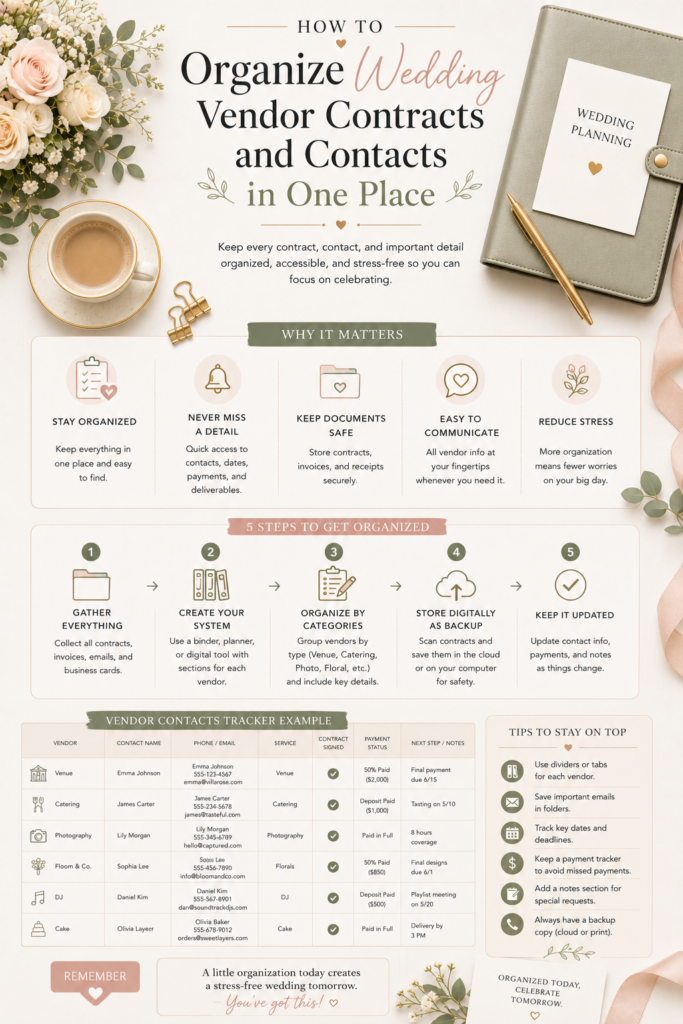
A typical wedding involves somewhere between eight and fifteen separate vendors — venue, caterer, photographer, videographer, florist, band or DJ, hair and makeup, transport, officiant, and often several more. Each one comes with its own contract, its own email thread, its own payment schedule, and its own set of specific details discussed across multiple conversations that are very easy to lose track of once they are scattered across inboxes, phone notes, and paper folders.
This scattering is not a minor inconvenience. It is one of the most common sources of genuine wedding planning stress — the sinking feeling of not being able to find a specific contract clause, or realizing a payment deadline passed because the confirmation email got buried three weeks ago, or forgetting exactly what was agreed with the florist about delivery timing.
A single, organized vendor management system solves this directly. This guide covers exactly what to track for each vendor, how to build a system that actually holds up across many months of planning, and how to keep it current without it becoming its own burdensome task.
Why Vendor Information Gets Lost So Easily
Communication happens across multiple channels. Email, phone calls, text messages, and in-person conversations all carry important details, but each lives in a different place, making it genuinely difficult to reconstruct a complete picture of any single vendor relationship from memory alone.
Contracts and quotes arrive at different stages of the process. An initial quote, a revised quote after a consultation, and a final signed contract may all contain slightly different details, and without a clear system, it becomes unclear which version reflects the actual, current agreement.
Payment schedules vary significantly between vendors. Some require a single deposit and final balance; others require multiple staged payments across several months. Without a consolidated view, tracking which payments are due when, across a dozen different vendors, becomes genuinely difficult to hold in memory alone.
Verbal agreements and small details discussed in conversation are the easiest to forget. A specific request made during a call — an extra hour of coverage, a particular song, a specific dietary accommodation — can be easily lost if not immediately documented somewhere reliable.
What to Track for Every Vendor
Basic Contact Information
Full business name, primary contact person, phone number, email address, and physical address if relevant.
Service Details and Scope
Exactly what is included in the agreed service — specific hours of coverage, specific deliverables, any add-ons or upgrades agreed upon. Being specific here prevents ambiguity later about what was actually promised versus what may have been discussed but not formally included.
Contract and Payment Details
The total contracted amount, the payment schedule with specific dates and amounts for each installment, and confirmation of what has already been paid versus what remains outstanding. This is arguably the single most important category to track accurately, given the genuine financial and relational stakes of a missed payment.
Key Dates and Deadlines
Beyond payment dates, note any vendor-specific deadlines — final headcount deadlines for caterers, final song list deadlines for musicians, final design approval deadlines for stationery or florals.
Specific Requests and Agreements
Any particular details discussed and agreed upon that go beyond the standard contract — a specific timing request, a particular product substitution, an accommodation for a specific need. Document these as soon as they are agreed, rather than relying on memory to recall them accurately months later.
Day-Of Logistics
Arrival time, setup requirements, specific contact person for day-of coordination, and any particular logistical needs — parking, loading access, power requirements for equipment. This information becomes especially critical in the final weeks and needs to be easily accessible, ideally consolidated into your overall wedding day timeline.
Building a System That Actually Works
Choose One Central Location for Everything
The single most important principle is consolidation. Whether a physical binder, a digital folder structure, or a dedicated wedding planner with vendor tracking pages, every piece of vendor information should ultimately live in one place, rather than remaining scattered across its original point of arrival.
Create a Dedicated Page or Section Per Vendor
Rather than a single master list attempting to capture everything about every vendor in one place, a dedicated section for each individual vendor — even a single page — allows for the specific detail each relationship requires without becoming cluttered or difficult to navigate.
Print or Save Physical Copies of Signed Contracts
Regardless of how the rest of your system is organized, keep an accessible copy of every signed contract specifically, since this is the document you would need to reference in the event of any dispute or confusion about agreed terms.
Use a Consolidated Payment Tracker Across All Vendors
In addition to individual vendor pages, maintain a single overview page listing every vendor’s payment schedule together, sorted by date. This combined view is what actually prevents a missed payment, since it shows your complete financial obligations across every vendor relationship in one glance, rather than requiring you to check each vendor’s individual page separately to catch an approaching deadline.
Log New Information Immediately, Not Retroactively
Details discussed verbally are particularly easy to lose if not documented promptly.
A Simple Template for Each Vendor Page
Vendor name and category:
Primary contact and phone/email:
Total contracted amount:
Payment schedule:
- Deposit: amount / due date / paid status
- Payment 2: amount / due date / paid status
- Final balance: amount / due date / paid status
Included services/deliverables:
Specific agreed requests or notes:
Day-of arrival time and logistics:
Key deadlines (headcount, song list, design approval, etc.):
This template, used consistently across every vendor, produces a genuinely complete, easily scannable record for each relationship, without requiring different formats or systems for different vendor types.
Keeping Your System Current Through the Full Planning Timeline
Do a monthly review of your entire vendor system, alongside your broader wedding planning check-in. Confirm upcoming payments, check for any outstanding communication that needs following up, and verify that your records still accurately reflect the current state of each relationship.
Reconfirm details directly with vendors as the wedding approaches, rather than assuming your records remain accurate. In the final one to two months, a brief check-in with each vendor — confirming date, time, and key details — catches any discrepancies between your records and the vendor’s own understanding before they become a problem on the actual day.
Using a Dedicated Wedding Planner for Vendor Tracking
A general notes app or scattered set of documents can work, but a purpose-built vendor tracking system — with consistent pages for each vendor, a consolidated payment overview, and space for day-of logistics — considerably reduces the effort required to keep everything organized compared to building this structure from scratch. Elabrille’s wedding planning bundle includes dedicated vendor contact and contract tracking pages designed specifically around this kind of consistent, per-vendor documentation, alongside the budget and timeline pages that connect directly to the same information.
Pulling It All Together
The number of separate vendor relationships involved in even a modest wedding makes a consolidated tracking system genuinely essential, not simply a nice-to-have organizational preference. Scattered information across emails, texts, and memory is precisely what causes missed payments, forgotten agreements, and the kind of avoidable stress that makes wedding planning feel more chaotic than it needs to be.
Build one central system. Give every vendor a consistent, dedicated page. Track payments both individually and in a consolidated overview. Log new agreements immediately, and reconfirm details directly with each vendor as your date approaches. This structure does not eliminate the genuine complexity of coordinating many vendors — but it ensures that complexity stays organized and manageable, rather than becoming a source of last-minute panic.
Frequently Asked Questions
What should I track for each wedding vendor?
Contact information, total contracted amount and payment schedule, included services and deliverables, specific agreed requests, day-of logistics, and any vendor-specific deadlines. Using a consistent template across every vendor makes the information easy to compare and reference quickly.
How do I keep track of multiple vendor payment deadlines at once?
Maintain a single, consolidated payment tracker listing every vendor’s payment schedule together, sorted by date, in addition to individual vendor pages. This combined view is what actually prevents a missed payment, since it shows your complete financial obligations across all vendors in one place.
Should I keep physical or digital copies of my vendor contracts?
Either works, but keep an easily accessible copy of every signed contract specifically, regardless of your broader system’s format. This is the document you would need to reference in the event of any dispute or confusion about agreed terms.
When should I reconfirm details with my vendors before the wedding?
In the final one to two months, do a direct check-in with each vendor confirming date, time, and key logistical details. This catches any discrepancies between your records and the vendor’s own understanding before they become a problem on the wedding day itself.
What’s the best way to organize vendor information if I’m not using a dedicated wedding planner?
Choose one central location — a binder, a digital folder, or a notes app — and create a consistent template for each vendor covering contact details, payment schedule, included services, and specific agreements. Consistency across every vendor’s page matters more than the specific tool used to organize it.