
Introduction – How to stay organised when working from home
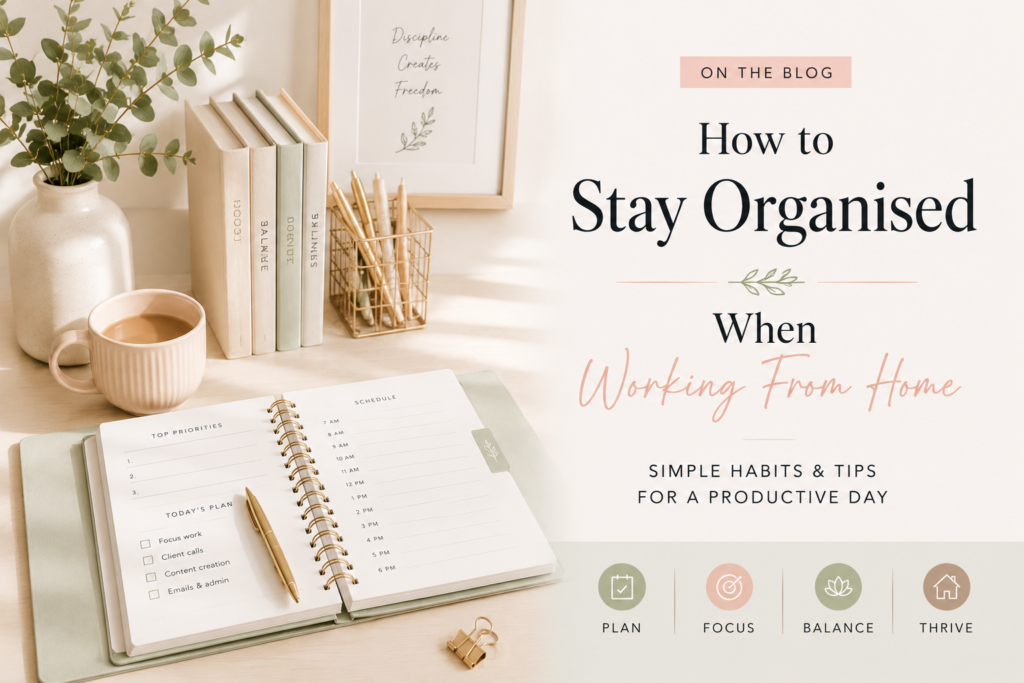
Working from home sounds ideal until you are three weeks in and your kitchen table has somehow become your office, your lunch break, and your evening relaxation space all at once. The laundry is calling your name during a Zoom call. Your focus disappears somewhere between your second coffee and your fourth notification. And by Friday afternoon you are not quite sure what you actually accomplished this week.
The freedom of working from home is real. But so is the chaos, if you let it be.
The difference between people who thrive working from home and people who constantly feel scattered is not discipline in the rigid, punishing sense. It is structure — a set of intentional habits and systems that create the boundaries and routines an office building would otherwise impose for you.
This guide covers everything you actually need to stay organised, focused, and genuinely productive when your home is also your workplace. Not vague advice, but specific habits you can start building from tomorrow morning.
1. Treat Your Workspace Like It Actually Matters
The single most impactful thing you can do for your work-from-home productivity is to have a dedicated workspace — and to treat it seriously.
This does not mean you need a spare room or an expensive home office setup. It means having a specific spot where work happens and where, ideally, only work happens. A corner of a room, a particular chair at the table, a desk that is yours during working hours. The physical cue matters more than most people realise.
When you sit in the same place to work every day, your brain learns to associate that space with focus. Over time, simply sitting down there begins to shift you into a working mindset. The reverse is also true — when you work from the sofa or in bed, your brain struggles to distinguish between rest and work, and both suffer.
Keep your workspace tidy. A cluttered desk creates a cluttered mind, and the research on this is fairly consistent. Before you finish each day, clear your workspace so that you start tomorrow with a clean slate rather than a physical reminder of everything you did not finish yesterday.
If you share your home with others, communicate clearly about what your workspace signals. When you are at your desk, you are at work. Establishing that boundary physically makes it easier to maintain it socially.
Start here: Decide on your workspace today if you have not already. Clear it, organise it, and commit to using it consistently for at least two weeks.
2. Build a Morning Routine That Does Not Involve Opening Your Laptop First
One of the fastest ways to lose control of your work-from-home day is to start it by immediately checking your email or messages. You hand the first hour of your day — when your mind is freshest and most capable — to other people’s agendas.
A morning routine creates a buffer between sleeping and working. It signals to your brain that the day is beginning intentionally, not reactively. And it gives you the grounded, focused starting point that makes everything else easier.
Your routine does not need to be elaborate. It might be thirty minutes of movement, a proper breakfast, fifteen minutes of journaling or planning, and getting dressed before you sit down to work. The specific activities matter less than the consistency and the sequence.
The act of getting dressed deserves a special mention. It sounds trivial. It is not. Changing out of pyjamas into something you would wear outside the house creates a psychological shift that working in sleepwear rarely produces. You do not need to be formal. You just need to feel like a person who is about to do professional work.
Start here: Write down what your ideal thirty to forty-five minute morning routine would look like. Try it for five days and notice the difference in how you start your working hours.
3. Set Your Working Hours and Protect Them
In an office, your working hours are defined for you. At home, without that external structure, work has a tendency to expand into every available hour — early mornings, lunch breaks, evenings, weekends. You are technically always available, so you always feel like you should be available.
This is not sustainable, and it is not actually more productive. Extended, boundary-free working hours lead to decision fatigue, creative depletion, and eventually burnout. The research on this is clear. Working more hours does not produce proportionally more output — especially for knowledge work that requires focus and creativity.
Set your start time and your finish time. Communicate them to your team, your clients, and the people you live with. Then honour them — both the start and the finish.
The finish time is the harder one for most remote workers. Give yourself a shutdown ritual that marks the end of the workday: close your tabs, write down your three priorities for tomorrow, tidy your desk, and physically move away from your workspace. That transition from work-mode to rest-mode is something your mind genuinely needs.
Start here: Decide on your working hours right now. Write them somewhere visible. Tell one person — a colleague, a partner, a friend — what they are.
4. Plan Your Day Before It Begins
Without the passive structure of an office environment — meetings that anchor your time, colleagues whose presence signals when the day starts and ends — your work-from-home day can easily drift. You are busy without being directed. You respond to things without making progress on things.
Planning your day takes this chaos and gives it a shape.
Every morning, before you open your inbox, take five to ten minutes to decide what you are actually going to do today. Not a long, ambitious list of everything you could possibly tackle. A short, realistic list of the two or three things that would make today genuinely productive.
Write down your most important task first. Then your secondary priorities. Then check your calendar for any fixed commitments and build your day around them. This entire process takes less time than you think, and the clarity it gives you lasts the entire day.
If you want to go a step further, time-block your day — assign specific tasks to specific windows of time rather than working through a list in whatever order feels easiest. Time-blocking removes the constant low-level decision of “what should I work on now?” and replaces it with a clear answer every time.
Start here: Tomorrow morning, before you open any app or message, spend five minutes writing down your top three priorities for the day. Do this for one full week and notice how differently your days feel.
5. Separate Communication Time from Deep Work Time
One of the most damaging habits in remote work is treating communication and focused work as if they can happen simultaneously. They cannot.
Every time you switch from a task to check a message and back again, your brain pays a switching cost. It takes time — research suggests up to twenty-three minutes in some cases — to fully return to deep focus after an interruption. If you are checking messages every fifteen minutes, you are never actually doing focused work. You are doing a fragmented, interrupted version of it that produces far less and costs far more.
The fix is simple but requires deliberate practice: separate your communication time from your deep work time.
Block out periods — perhaps ninety minutes to two hours in the morning — where you close your email, silence your notifications, and work on your most important task without interruption.
This might feel uncomfortable at first, especially if your workplace culture expects instant responses. But most things that feel urgent are not actually urgent. Most messages can wait two hours for a thoughtful reply, and the work you produce in that protected time is worth the slight delay.
If you need to, communicate your approach to your team. “I am in focused work mode until 11am, then available for messages” is a completely reasonable boundary in a healthy remote work environment.
Start here: Tomorrow, put your phone face-down and close your email for the first ninety minutes of your workday. See what you can produce.
6. Use a Physical Planner Alongside Your Digital Tools
Digital tools are powerful. They sync across devices, they send reminders, and they can hold an almost unlimited amount of information. But there is a reason many of the most productive remote workers still reach for a physical planner or notebook every day.
Writing by hand activates your brain differently from typing. When you write something down — a priority, a goal, a task — you process it more deeply. You are more likely to remember it. And crucially, you are more likely to commit to it.
A physical planner also exists outside the screen where all your distractions live. When you open your laptop to check your digital to-do list, you are one click away from your inbox, your social feeds, and every notification that has built up. A paper planner lives on your desk and requires nothing from you except your attention.
Use your digital calendar for meetings and appointments that need reminders and syncing. Use a physical planner for your daily priorities, your weekly intentions, and your habit tracking. The two systems work together rather than competing.
If you are working from home and feeling like your days blur into each other, a physical planner adds a grounding ritual — the act of sitting down, writing out your plan, and closing it at the end of the day — that no app quite replicates.
Start here: If you do not already use a physical planner, try it for two weeks alongside your existing digital tools. Many people who start this do not go back.
7. Manage Your Energy, Not Just Your Time
Time management is only half the picture. The other half is energy management — and remote work can quietly drain your energy in ways that a traditional office does not.
When you work from home, you lose the natural energy cues that an office provides. The commute that created a transition. The lunch break away from your desk. The brief conversations with colleagues that break up the day. Without these, it is easy to work in a flat, continuous low-energy state for hours — technically present but never quite sharp.
Pay attention to your energy patterns across the day. Most people have a peak performance window — a period of two to four hours when their focus and thinking are genuinely at their best. Identify yours and protect it fiercely for your most important work. Use your lower-energy periods for administrative tasks, emails, and things that require less creative thought.
Take real breaks. Not “browse Instagram for five minutes while still half-thinking about work” breaks, but genuine breaks — step outside, make a proper cup of tea, do five minutes of stretching, have a proper lunch away from your screen. These breaks do not slow you down. They refuel you for the hours ahead.
Move your body during the day. One of the most underestimated costs of remote work is the dramatic reduction in incidental movement. In an office, you walk to meetings, walk to get coffee, walk between floors. At home, you can go entire days barely leaving your chair. Build intentional movement into your day — a short walk at lunch, a stretching break mid-afternoon, anything that gets you out of your seat.
Start here: For one week, track when you feel most energised and focused during the day. Then reorganise your schedule so your most important work falls in that window.
8. Create Clear Boundaries Between Work and Home Life
This is perhaps the deepest challenge of working from home, and the one that causes the most long-term damage when it goes unmanaged.
When your home is your office, the boundary between the two has to be created deliberately — because it will not create itself. Without it, you are never fully at work and never fully at rest. You are perpetually in a middle state that exhausts you without satisfying either need.
Physical boundaries help. A designated workspace that you leave at the end of the day. A laptop that closes at a specific time. A phone that goes on silent after hours. These physical cues signal to your brain that mode has shifted.
Temporal boundaries matter equally. Defined working hours respected consistently over time train your mind to switch into and out of work mode reliably. This takes weeks to establish but becomes increasingly automatic once it does.
Communicate your boundaries clearly to the people you live with. If you have children, a partner, or housemates, they need to understand when you are working and when you are not — both for your sake and for the quality of the time you share with them when you are not working.
And perhaps most importantly, be honest with yourself about whether you are actually resting when you are supposed to rest. Many remote workers technically stop working but spend their evenings ruminating on work problems, checking messages one more time, or feeling vaguely guilty about what they did not finish. That is not rest. Real rest means genuinely letting go of work — trusting that tomorrow’s plan is in place and that you have done enough for today.
Start here: Write down three specific boundaries you want to maintain as a remote worker. Share them with someone who will notice if you consistently break them.
9. Batch Similar Tasks Together
Context switching — jumping between completely different types of work throughout the day — is one of the biggest hidden costs of unstructured remote work. Every switch carries a mental cost. Every shift in context requires your brain to reorient itself.
Batching similar tasks together eliminates much of this friction.
Instead of answering one email, then doing thirty minutes of creative work, then making a phone call, then going back to email, group all your emails together in one window.
When your brain stays in the same mode for an extended period, it gets into a flow that produces better work in less time. You are not constantly spinning up and winding down. You are running at a consistent speed in a consistent direction.
For remote workers specifically, this might look like: emails and messages from 9 to 10am, focused project work from 10am to 12:30pm, meetings and calls in the early afternoon, administrative tasks from 4 to 5pm. The exact structure depends on your role and your team, but the principle applies universally.
Start here: Look at your typical day and identify the main categories of work you do. Group them into batches and try structuring your day around those batches for one week.
10. Do a Weekly Review to Stay on Top of the Bigger Picture
Daily organisation keeps you productive hour to hour. But without a wider view, it is easy to spend weeks being busy without making meaningful progress on the things that actually matter.
A weekly review — thirty to forty-five minutes, once a week — is what keeps your daily work connected to your bigger goals.
Use this time to look back at the week that just finished: what did you accomplish, what stalled, what took longer than expected, and what came up unexpectedly. Then look forward: what are the most important things to move forward next week, and what does your calendar look like?
This review is also the right moment to check in on your longer-term projects and goals. Are you moving in the right direction? Is anything being consistently neglected that deserves more attention? Are there things on your plate that no longer deserve to be there?
Working from home can create a tunnel vision where you are always close to your work and never quite able to see the wider landscape. The weekly review lifts you above the day-to-day and gives you perspective — which is often exactly what you need to make better decisions about where your time and energy actually go.
Start here: Block thirty minutes in your calendar every Friday afternoon or Sunday evening labelled “weekly review.” Treat it as non-negotiable for four weeks and observe the difference.
Building Your Work-From-Home Organisation System
Reading through these ten habits, you might be thinking: I cannot implement all of this at once. You are right — and you should not try to.
Start with one or two habits that feel most relevant to your current situation.
Each habit you establish makes the next one slightly easier. Organisation compounds in the same way that disorganisation does — except the outcome is entirely different.
The goal is not a perfect, rigid system. It is a flexible structure that gives your working-from-home life enough shape that you can actually thrive in it — doing great work during your working hours and genuinely resting outside of them.
That balance is entirely achievable. It just needs to be built deliberately.
Frequently Asked Questions
How do I stop getting distracted when working from home?
Start by identifying your most common distractions — household tasks, social media, family interruptions, or the pull of your phone. Then design specific solutions for each one: a dedicated workspace away from household activity, app blockers during deep work periods, communicated boundaries with people at home, and your phone in another room or on do-not-disturb during focused hours.
How do you maintain work-life balance when working from home?
Define your working hours clearly and stick to them. Create a physical and psychological end-of-day ritual that signals the switch from work mode to personal time. Avoid checking work messages in the evening. Make sure your evenings include something genuinely restorative — time with people you care about, movement, creative pursuits, or simply proper rest.
What is the best daily routine for working from home?
A strong work-from-home routine typically includes: a consistent wake-up time, a morning routine before opening your laptop, a five-minute daily planning session, protected deep work blocks, defined communication windows, a proper lunch break away from your screen, and a clear shutdown time with a brief end-of-day ritual. The specific structure depends on your role and natural rhythms — but consistency matters more than perfection.
How do I stay motivated when working from home alone?
Motivation tends to follow action rather than precede it — so starting is often more important than feeling motivated first. Concrete daily goals give you something specific to achieve. Regular check-ins with colleagues or accountability partners maintain connection. Tracking your progress visually (a habit tracker or task completion list) makes your output feel real. And protecting your energy through movement, breaks, and proper sleep keeps your baseline motivation much higher.
Is it better to use a paper planner or an app when working from home?
Many remote workers find a combination works best: digital calendars for meetings and shared scheduling, and a physical planner for daily priorities, intentions, and habit tracking. The physical planner keeps your most important tasks visible without requiring you to open a device — which removes one route to distraction. If you only want one system, choose the one you will actually open and use every single day.