
Introduction – Printable Planner vs Digital Planner
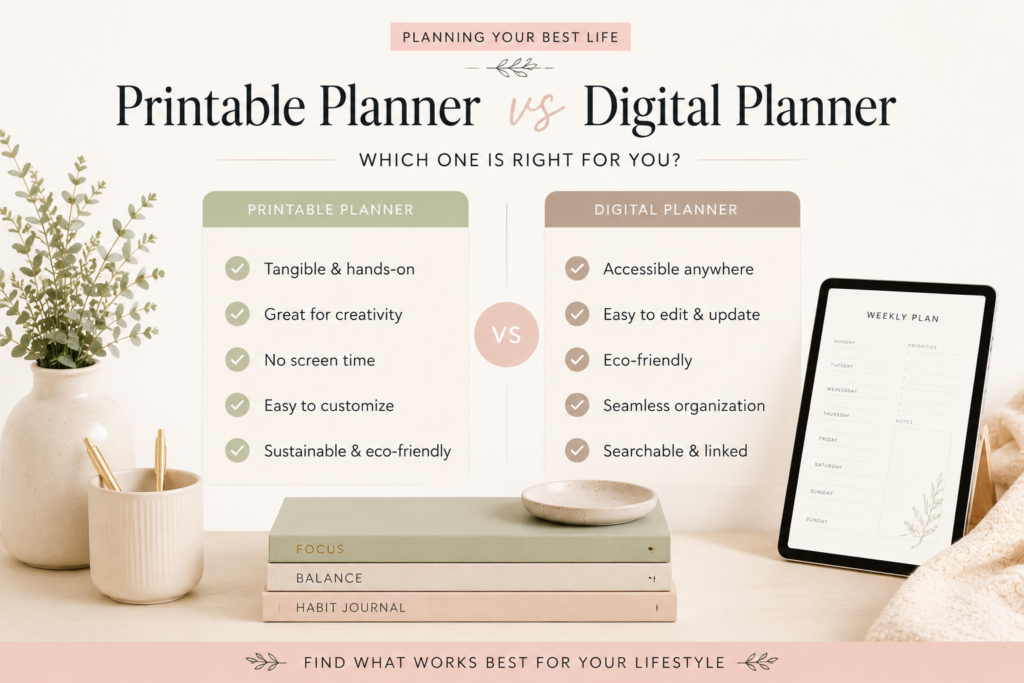
It is one of the most common questions in the planning community — and one that somehow never gets a clean answer.
Should you use a printable planner or a digital planner?
Both camps have passionate advocates. On one side, there are people who swear that nothing beats the feeling of pen on paper, a beautifully designed printable page, and the tactile satisfaction of physically crossing something off. On the other, there are people who cannot imagine going back to paper — their digital planner syncs across every device, never runs out of pages, and lives in the same app where their calendar and notes already live.
The honest answer is that neither is universally better. But one of them is probably better for you — based on how you think, how you work, and what you actually need from a planning tool.
This guide breaks down the real differences between printable and digital planners across every dimension that matters: cost, flexibility, focus, portability, creativity, and long-term sustainability. By the end, you will know clearly which direction is right for you — and why.
What Is a Printable Planner?
A printable planner is a digital file — usually a PDF — that you download and either print at home or at a print shop, then use with a pen or pencil just like any physical planner.
The key advantage of this format is that it combines the best of both worlds in one important sense: you get a professionally designed, beautifully formatted planning layout without paying the price of a premium physical planner. You download it once, print as many copies as you need, and you are ready to go.
Printable planners come in a wide range of formats — daily pages, weekly spreads, monthly overviews, habit trackers, goal-setting sheets, meal planners, budget trackers, and more. Many are sold as bundles, giving you a complete planning system in a single purchase that you can print and assemble however works best for you.
They work in a standard binder or planner cover, on a clipboard, or simply stacked on your desk. Some people punch holes and organise them into sections. Others print only what they need each week. The flexibility of the format is part of its appeal.
What Is a Digital Planner?
A digital planner is a planning tool that exists entirely on screen — either as an interactive PDF used with a stylus on a tablet, a dedicated planning app, or a template within a productivity platform like Notion, Google Docs, or similar tools.
Interactive digital planners are designed to be used with apps like GoodNotes, Notability, or PDF Expert on an iPad or Android tablet. They often include hyperlinked tabs for easy navigation between sections and mimic the look and feel of a physical planner — but entirely on screen, with the ability to write by hand using a stylus, type text, add stickers, highlight, and erase without waste.
App-based digital planners — tools like Notion, Sunsama, TickTick, or Todoist — take a different approach. Rather than replicating the look of a paper planner, they organise your tasks, goals, and habits through databases, lists, and calendar views that are purpose-built for screens.
Both types of digital planners have strong followings, and which you prefer often comes down to whether you want your digital planner to feel like paper or to work like software.
The Case for a Printable Planner
Writing by Hand Improves Focus and Retention
There is genuine science behind the preference for paper. Research into note-taking consistently finds that people who write by hand process and retain information more deeply than those who type. When you write something down with a pen, you are doing more than recording it — you are engaging with it in a way that typing does not replicate.
For planning specifically, this means that writing your priorities by hand tends to create a stronger sense of commitment than typing them into an app. The physical act of forming the words, slowly and deliberately, makes them feel more real and more binding.
If you have ever typed a to-do list and then completely forgotten about it, you are not alone. There is something about a handwritten list that keeps pulling your attention back in a way a screen notification often cannot.
No Screen, No Distractions
This one is simple but significant. When your planner is a piece of paper on your desk, opening it to check your priorities does not put you one tap away from your inbox, your social media, your messages, or every other digital distraction competing for your attention.
For people who struggle with screen-based distractions — and most of us do, to some degree — a printable planner creates a genuine offline zone in their day. You sit down with your planner and your pen, and there is nothing else there. Just your thoughts and your plan.
This is particularly valuable in the morning, when many productivity experts recommend keeping screens away as long as possible to preserve mental clarity. A printable planner lets you plan your day fully before you have looked at a single notification.
The Satisfaction Is Real
Let us not underestimate the motivational power of physically crossing something off a list or filling in a habit tracker square with a coloured pen. It is small, it is tactile, and it works.
The act of marking a completed task produces a small but genuine sense of satisfaction — a micro-reward that reinforces the behaviour. Many people find this far more motivating than ticking a digital checkbox, which produces no physical sensation at all.
For people who enjoy stationery, beautiful layouts, and the ritual of sitting down with a cup of tea and a well-designed page, a printable planner is not just functional. It is genuinely enjoyable. And tools you enjoy using are tools you actually use.
Affordable and Immediately Available
A high-quality printable planner bundle typically costs a fraction of what you would pay for a premium physical planner from a stationery brand — and you get it instantly. No shipping, no waiting, no worrying about the postman. Download, print, and start planning the same day.
Because printable planners are files you own permanently, you can reprint pages whenever you need them. Run out of weekly spreads halfway through the year? Print more. Want to try a different daily layout? Print a test page before committing. This flexibility makes printable planners significantly more cost-effective over time.
Fully Customisable to Your Preferences
With a printable planner, you are in complete control of how your system looks and works. Print only the pages you use. Adjust the print size to suit your binder. Mix and match pages from different templates to build a custom system. Use a highlighter, a fountain pen, washi tape, or stickers — whatever makes the experience enjoyable for you.
This level of personalisation is something digital planners, for all their features, often struggle to match.
The Case for a Digital Planner
Everything Is in One Place and Always With You
Your phone or tablet is almost certainly already with you everywhere you go. A digital planner that lives on that device means your planning system is always accessible — on the train, between meetings, waiting in a queue, or at your desk.
We never forget it at home. Us never run out of pages. You never have to transfer information from a physical planner to a calendar app because they are already in the same ecosystem.
For people who travel frequently, work across multiple locations, or simply prefer to carry as little as possible, the portability of a digital planner is a genuine practical advantage that a printable planner cannot match.
Easy to Edit, Reorganise, and Update
Life changes. Plans change. Priorities shift mid-week and meetings move and tasks get delegated. In a printable planner, changes mean crossing things out, squeezing text into margins, or reprinting pages. In a digital planner, they mean a few taps or keystrokes.
The ability to edit without making a mess is something digital planners handle effortlessly. If you work in a fast-moving environment where your schedule changes frequently, the flexibility of digital editing can save you real time and frustration.
Reminders and Notifications Keep You on Track
Paper cannot tap you on the shoulder at 2pm to remind you about a 3pm meeting. A digital planner or planning app can — and for people who tend to get absorbed in work and lose track of time, automated reminders are not just convenient but genuinely important.
If your planning needs include time-sensitive reminders, recurring tasks, or integration with a shared team calendar, digital tools have capabilities that paper simply cannot offer.
Environmentally Conscious Option
For people who are mindful about paper consumption, a fully digital planning system has an obvious environmental advantage. No printing, no physical waste, no ink cartridges. Everything lives on a device you already own.
This is not a reason to choose digital over printable if paper genuinely works better for you — but it is a factor worth acknowledging for anyone who weighs environmental impact in their purchasing decisions.
Searchable, Shareable, and Backed Up
Digital planners can be searched, which becomes increasingly valuable as your planning history grows. Looking for a note you made three months ago about a project? A digital planner surfaces it in seconds. A physical one requires you to remember roughly when you wrote it and then leaf through pages.
Digital files are also easy to back up, share with others, and access across multiple devices. For collaborative planning or for people who want a permanent, searchable record of their goals and progress, these features add real value.
Head-to-Head Comparison
Here is how the two formats compare across the dimensions that matter most to most planners:
Cost: Printable planners win on value — especially bundles. You pay once and print indefinitely. Digital planner apps often involve subscriptions or premium tiers on top of the cost of the planner itself.
Focus and distraction: Printable planners win clearly. Paper is offline by nature. Opening a digital planner on the same device as your messages, social media, and email puts you permanently adjacent to distraction.
Portability: Digital planners win. Your tablet or phone goes everywhere. A printed planner stays where you left it.
Flexibility to edit: Digital planners win easily. Changes are clean, quick, and unlimited.
Tactile satisfaction: Printable planners win for people who enjoy writing by hand. The satisfaction of pen on paper is something no screen has fully replicated.
Reminders and automation: Digital planners win. Paper cannot send you a notification.
Creativity and personalisation: Printable planners win for those who enjoy decorating and customising their pages. Digital planners win for those who want to customise layouts and structures without any physical materials.
Environmental impact: Digital planners have the edge, though the difference is smaller than it might seem once printer ink and device manufacturing are factored in.
Cognitive engagement: Printable planners win. Research consistently supports the cognitive benefits of writing by hand over typing.
Who Should Choose a Printable Planner?
A printable planner is likely the better fit for you if:
You enjoy writing by hand and find it more satisfying and focused than typing. You struggle with screen-based distractions and want your planning to happen entirely offline. Us like a tactile, visual planning experience — filling in habit trackers, colour-coding your week, using stickers or washi tape. We want a cost-effective planning system that you can customise and reprint freely. Us have a relatively stable schedule that does not require constant digital editing. We are building new habits and want the reinforcement of physically marking off completed behaviours. Us simply prefer paper and always have — trust that instinct.
Who Should Choose a Digital Planner?
A digital planner is likely the better fit for you if:
You work primarily on a tablet or laptop and want your planner in the same ecosystem. You travel frequently or work across multiple locations and need everything accessible on one device. Your schedule changes often and you want to edit and reorganise your plan without making a mess.
Can You Use Both?
Absolutely — and many people do.
A very common hybrid approach is to use a digital calendar for fixed appointments, meetings, and shared scheduling, and a printable planner for daily priorities, habit tracking, and weekly intentions. The two systems complement each other rather than competing.
The digital calendar handles the things that need reminders, syncing, and shared access. The printable planner handles the things that benefit from handwriting, focus, and the tactile ritual of planning. Together, they cover everything.
If you are unsure which format suits you, trying both for a few weeks before committing is always a reasonable approach. Print a few pages from a planner bundle and use them alongside whatever digital tool you currently have. Notice which one you reach for more instinctively. That instinct usually tells you what you need to know.
A Note on Planner Bundles
Whether you go printable, digital, or a combination of both, buying your planning tools as a bundle rather than piecing them together one item at a time almost always makes sense.
A well-designed planner bundle gives you a complete, cohesive planning system in one purchase — daily pages, weekly spreads, monthly overviews, habit trackers, and goal-setting pages that are all designed to work together. You get better value, better design consistency, and a ready-to-use system from day one instead of spending time hunting for the right combination of individual products.
Printable planner bundles in particular offer exceptional value — pay once, print as many times as you need, and customise the layout to suit how your planning needs evolve over time.
Pulling It All Together
The printable planner versus digital planner debate does not have a universal winner — but it does have a right answer for you, and it is probably clearer than you think.
If you are drawn to the ritual of handwriting, want to keep your planning offline and distraction-free, and love a beautiful, customisable page you can hold in your hands — a printable planner is your answer.
If you live on your devices, need your plan with you everywhere, want easy editing and reminders, and prefer a clean digital interface — a digital planner is the better fit.
And if you want a bit of both — use them together. There are no rules, only what works.
The best planner is not the one with the most features or the most followers on social media. It is the one you actually open, use consistently, and close at the end of the day feeling like your time was well spent.
Start there. Everything else follows.
Frequently Asked Questions
Is a printable planner better than a digital planner?
Neither is objectively better — it depends entirely on how you think and work. Printable planners are better for focus, tactile satisfaction, and offline planning. Digital planners are better for portability, editing flexibility, and integration with reminders and calendars. Many people find a combination of both works best.
Can I use a printable planner on my iPad?
Yes — many printable planner PDFs can be imported into apps like GoodNotes or Notability and used with a stylus on an iPad. This gives you the look and feel of a paper planner with the editing flexibility of a digital tool. It is a popular middle-ground option.
What is the best app for a digital planner?
For tablet-based digital planners used with a stylus, GoodNotes and Notability are the most widely used and highly rated. For app-based digital planning, Notion, Sunsama, and Todoist are popular choices. The best app depends on whether you want your digital planner to feel like paper or work like productivity software.
How much does a printable planner cost?
Printable planner pages and bundles vary widely in price, but quality bundles are typically very affordable compared to premium physical planners — often a fraction of the cost. The value is especially strong because you can reprint pages as many times as you need from a single purchase.
What should a good planner include?
A complete planner should include daily planning pages, a weekly overview, a monthly calendar, a habit tracker, and a goal-setting section. Some also include meal planners, budget trackers, project planning pages, and reflection prompts. The most important thing is that all the components work together as a cohesive system rather than a loose collection of unrelated pages.