
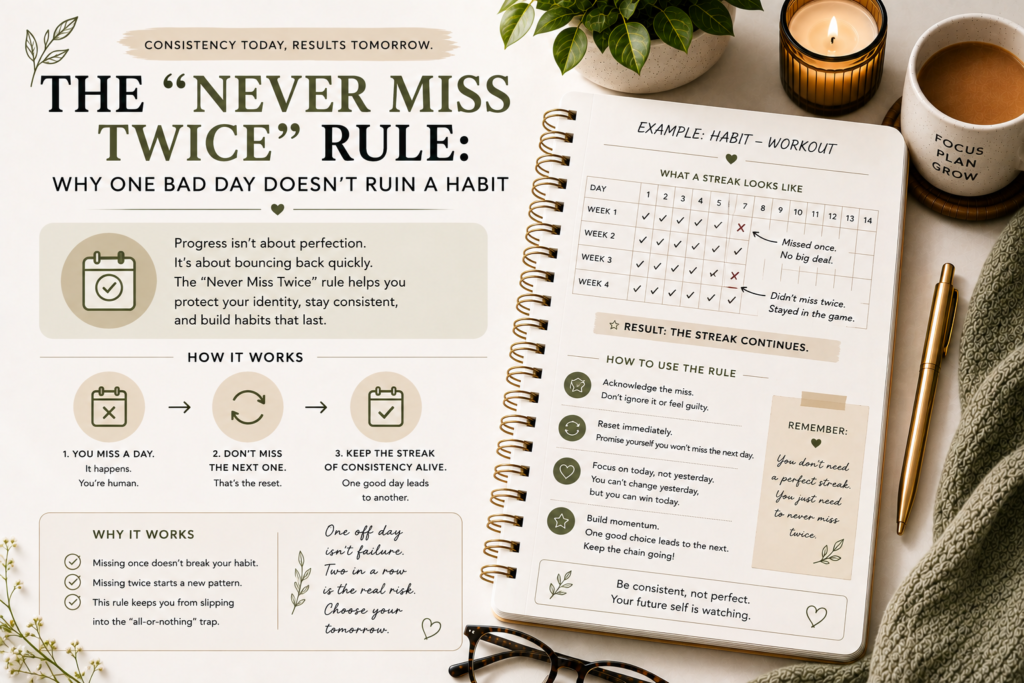
Almost every habit that has ever been abandoned did not fail because of a single missed day. It failed because of what happened after that missed day — a second miss, then a third, until the original habit had quietly, gradually disappeared without any single dramatic moment of decision to stop.
This pattern is so consistent across habit research and lived experience that it has produced one of the simplest, most genuinely useful principles in habit formation: never miss twice. The rule does not ask for perfection. It does not treat a single missed day as any kind of meaningful failure at all. It asks for exactly one thing — that whatever happened yesterday, you return to the habit today, before a second consecutive miss has the chance to establish a new, competing pattern.
This guide covers exactly why this simple rule works so effectively, the psychology behind why a single miss rarely matters but a second one matters considerably more, and how to build the rule into a genuinely useful, practical response for the inevitable days your habits do not go as planned.
Why a Single Missed Day Matters So Little
Research on habit formation consistently finds that occasional missed days have minimal measurable impact on long-term habit strength. Studies tracking habit formation over extended periods find that a single missed opportunity does not meaningfully disrupt the overall trajectory toward a habit becoming automatic, provided the pattern of consistent practice resumes shortly afterward.
A habit is a pattern built through repetition over time, not a fragile streak broken irreparably by any single interruption. The underlying neural and behavioural changes that make a habit feel automatic develop gradually, through cumulative repetition. A single missed instance does not erase this accumulated progress, in the same way a single missed workout does not erase months of accumulated fitness.
Perfectionist thinking around habits often causes more damage than the actual missed day itself. Treating a single miss as a significant failure — rather than a normal, expected part of maintaining any habit over an extended period — tends to trigger discouragement disproportionate to the actual, minor setback, which can itself become the genuine threat to the habit’s continuation.
Why the Second Consecutive Miss Matters Considerably More
Two consecutive misses begin to establish a competing pattern. While a single miss is simply an interruption, a second consecutive miss starts to resemble a new, alternative pattern — not doing the habit — which, left unaddressed, can develop its own momentum in precisely the way the original habit did.
The psychological narrative shifts meaningfully after a second miss. A second consecutive miss starts to invite a different narrative — perhaps the habit is not really working, perhaps this was never going to stick — a story that, once it takes hold, becomes considerably more difficult to resist than the original discomfort of simply returning to the habit would have been.
Momentum, once lost across multiple days, becomes genuinely harder to rebuild than to maintain. Returning to a habit after one missed day requires relatively little — simply doing the behaviour again as normal. Returning after several consecutive missed days often requires overcoming a more established pattern of not doing the behaviour, along with whatever discouraging narrative has developed in the interim.
What the “Never Miss Twice” Rule Actually Asks of You
The rule is deliberately narrow and specific, and understanding exactly what it does and does not require is part of what makes it so genuinely useful.
It does not ask for perfect, unbroken consistency. Missing a day, for any reason, is fully acceptable and expected under this rule. The rule makes no judgment about the miss itself.
It asks only for the very next opportunity to be honoured. Whatever prevented yesterday’s habit — illness, a genuine emergency, simple forgetting, low motivation — today’s version of the habit should still happen, in whatever reduced or scaled-back form is genuinely achievable.
It does not require compensating for the missed day. The rule is not asking you to do double the habit today to make up for yesterday’s miss. It is asking only that today’s normal version of the habit occurs, resuming the pattern rather than extending the interruption.
It applies regardless of the reason for the original miss. Whether the miss was entirely unavoidable or simply a lapse in motivation, the rule’s response is identical: return today, without needing to first resolve or fully understand why yesterday did not go as planned.
How to Actually Apply the Rule
Recognise a Missed Day Without Excessive Self-Judgment
When a habit is missed, note it honestly — in your tracker, in your own awareness — without attaching significant emotional weight or self-criticism to the miss itself. A missed day is information, not a verdict on your character or capability.
Lower the Bar for Today’s Version if Necessary
If the circumstances that caused yesterday’s miss are still partially present today — genuine time pressure, low energy, ongoing disruption — consider a scaled-down version of the habit rather than either the full version or another complete miss. A two-minute version of an exercise habit, or a single sentence of a writing habit, still counts as maintaining the pattern, even though it falls short of your usual, fuller version.
Resume the Habit at Its Normal, Scheduled Time
Rather than waiting for a symbolically “clean” restart point — the beginning of a new week, a new month — resume the habit at its next normal occurrence, whenever that happens to fall. Waiting for a symbolic fresh start often extends the interruption considerably longer than necessary.
Avoid Analysing the Miss Extensively Before Resuming
While some reflection on patterns of missed days can be genuinely useful during a broader weekly or monthly review, this analysis should happen separately from the immediate decision to resume the habit. Do not make today’s return to the habit contingent on first fully understanding why yesterday did not happen — simply return, and reflect separately if useful.
Track Both Your Consistency and Your Recovery Specifically
This provides a genuinely useful, separate measure of resilience, distinct from raw consistency alone.
Why This Rule Is More Effective Than Aiming for Perfection
Aiming for unbroken perfection sets up an all-or-nothing dynamic that a single missed day inevitably breaks. Once perfection is no longer possible — which happens the first time any day is missed — an all-or-nothing mindset can produce a sense that the entire effort has already failed, removing any remaining incentive to continue.
The never-miss-twice rule remains achievable even after an imperfect start. Because the rule’s only requirement is the very next opportunity, it remains fully achievable regardless of how many days have previously been missed, in contrast to a perfect streak, which becomes permanently unachievable the moment any single day is missed.
This rule directly addresses the psychological pattern where a single lapse leads to complete abandonment. The never-miss-twice rule interrupts this pattern directly, by explicitly reframing a single miss as fully compatible with continued, genuine success.
Applying the Rule Beyond Individual Habits
While most commonly discussed in relation to individual habits like exercise or reading, the same underlying principle applies usefully to several other areas.
Weekly planning and review practices. Missing a single week’s planning session does not undo the value of previous consistent planning. Returning to the practice the following week, rather than allowing the interruption to extend, preserves the overall benefit.
Budgeting and financial tracking. A single month of inconsistent budget tracking does not undermine an otherwise established financial habit. Resuming careful tracking the following month, rather than abandoning the practice entirely, maintains the broader financial benefit.
Sleep and wind-down routines. A single night without your usual evening routine does not meaningfully disrupt an otherwise well-established sleep pattern. Returning to the routine the following night, rather than allowing several nights of disruption to compound, preserves its overall benefit.
Common Misapplications of the Rule
Using the rule to justify frequent, casual misses because “it’s fine, I just won’t miss twice.” The rule is meant as a recovery principle for the inevitable, occasional miss, not as permission for a habitually inconsistent practice punctuated by frequent single-day misses. If misses are becoming genuinely frequent, this suggests the underlying habit design — its size, timing, or trigger — likely needs adjustment, rather than simply relying on recovery after each individual miss.
Applying excessive pressure to the “recovery” day itself. While the rule asks for a return on the very next opportunity, this return should still follow the general principle of starting small and reducing resistance where necessary, rather than adding significant pressure to perform an especially demanding version of the habit specifically because a recovery is “required.”
Treating a genuinely necessary pause — illness, a significant life disruption — the same as an ordinary, avoidable miss. The rule’s underlying spirit is about preventing casual, motivation-driven interruptions from compounding, not about forcing a habit’s resumption during a period that genuinely calls for rest or adjustment. Use judgment about which category a particular interruption falls into.
Pulling It All Together
The never-miss-twice rule offers a deliberately simple, achievable standard: not perfection, but a consistent return, at the very next opportunity, regardless of what happened before.
This single, modest commitment — resuming rather than compounding — is frequently the difference between a habit that survives a genuinely difficult stretch and one that quietly disappears from it. Track your misses honestly. Lower the bar for your recovery day if genuinely needed. And return, without waiting for a symbolic fresh start, at the very next chance the habit presents itself.
Frequently Asked Questions
Why does missing a habit once not really matter, but missing it twice does?
A single miss is easily understood as an isolated interruption without disrupting the overall accumulated pattern of a habit. A second consecutive miss begins to establish an alternative pattern — not doing the habit — which can develop its own momentum, along with a discouraging narrative that makes returning to the original habit considerably more difficult than after just one miss.
Does the never-miss-twice rule mean I have to do extra to make up for a missed day?
No — the rule does not require compensating for a missed day. It asks only that the habit’s normal, scheduled version occurs at its next opportunity, resuming the established pattern rather than extending the interruption. Adding pressure to “make up” for a miss is not part of the rule and can add unhelpful, unnecessary difficulty to the recovery.
What should I do if I keep missing my habit frequently, not just occasionally?
Frequent misses suggest the underlying habit design likely needs adjustment, rather than relying solely on recovery after each individual miss. Consider whether the habit is too large, poorly timed, or lacking a reliable trigger, and address these underlying factors directly rather than only applying the never-miss-twice recovery principle to an habit that may need more fundamental redesign.
Does this rule apply to things other than personal habits, like work routines or financial tracking?
Yes — the same underlying principle applies usefully to many recurring practices, including weekly planning sessions, budgeting and financial tracking, and wind-down routines. In each case, a single missed instance has minimal impact on the overall established pattern, provided the practice resumes at its next normal opportunity rather than allowing the interruption to extend across multiple instances.