
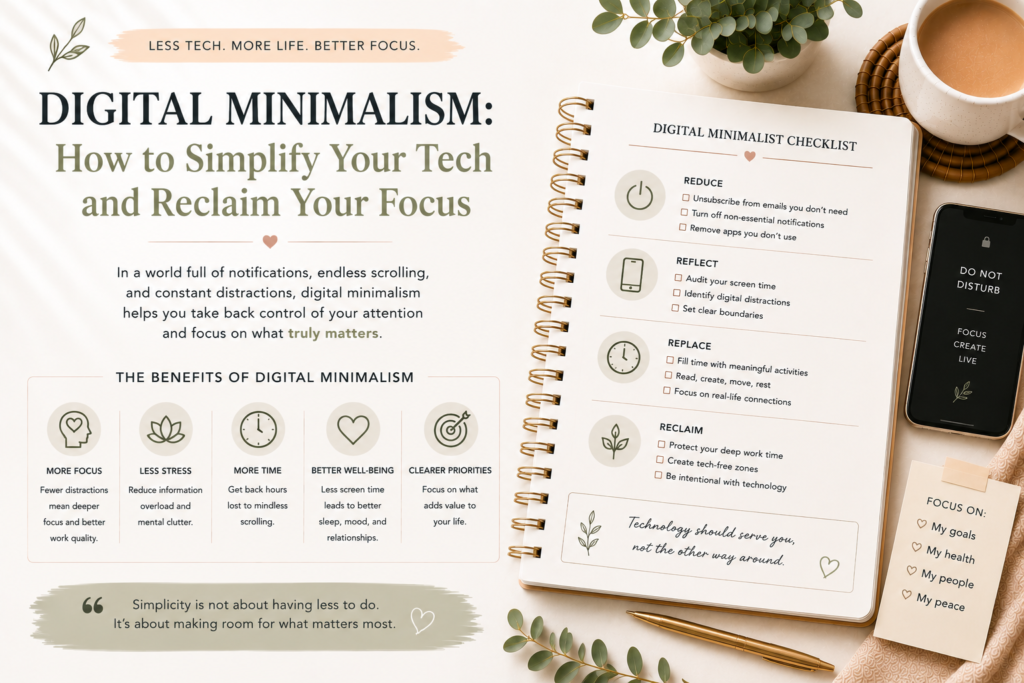
Most people’s relationship with technology was never actually chosen — it accumulated. An app downloaded for one specific purpose that quietly became a daily habit. A notification setting left at its default, aggressive configuration. A phone that somehow became the first thing checked in the morning and the last thing checked at night, without any single deliberate decision that produced this particular pattern.
Digital minimalism, a term popularised by computer scientist and author Cal Newport, offers a different approach: rather than accumulating technology use passively, it asks you to deliberately choose which digital tools genuinely serve your values and goals, and to consciously remove or limit everything else. This is not a rejection of technology itself, and it does not require an extreme, all-or-nothing withdrawal from digital life. It is a philosophy of intentionality — using technology because it genuinely adds value, rather than because it happened to accumulate.
This guide covers what digital minimalism actually involves, why the current default relationship with technology tends to work against genuine focus and wellbeing, and a practical framework for building a more deliberate digital life.
What Digital Minimalism Actually Means
Digital minimalism is the practice of being genuinely selective and intentional about which digital tools and platforms you use, based on whether they provide clear, meaningful value aligned with what you actually care about — rather than using a tool simply because it exists, because everyone else uses it, or because it has quietly become habitual over time.
This is distinguished clearly from digital abstinence or a complete rejection of technology. A digital minimalist may still use social media, still own a smartphone, still engage with various digital tools — but each is used deliberately, with clear boundaries, rather than accumulated passively and engaged with reactively throughout the day.
Why Most People’s Default Digital Relationship Works Against Them
Many digital platforms are specifically designed to maximise engagement, not to serve your genuine interests. Features like infinite scroll, autoplay, and variable reward notifications are deliberately engineered, often by teams specifically dedicated to this purpose, to capture and hold attention for as long as possible — a goal that frequently runs directly counter to your own genuine wellbeing or productivity.
Notification defaults are typically set to maximise app opens, not to serve your actual needs. Most applications default to notifying you about considerably more than genuinely requires real-time attention, precisely because more notifications generally correlate with more frequent app engagement, regardless of whether that engagement provides you with genuine value.
Constant, low-level digital engagement fragments attention in ways that compound over time. Frequent small interruptions from notifications and habitual app-checking do not simply cost the moment of the interruption itself — they appear to gradually reduce overall capacity for sustained attention, making genuinely deep focus progressively harder to access even during periods intentionally set aside for it.
The accumulated, unexamined nature of most digital habits means they rarely reflect genuine, deliberate choice. Few people have ever sat down and consciously decided, “yes, I want to spend this many hours per day on this specific platform.” The pattern accumulated gradually, through habit and design, rather than through any single deliberate decision.
The Core Principles of Digital Minimalism
Clutter is costly. Every additional app, notification, and digital habit carries a cumulative cost in attention and mental bandwidth, even when each individual element seems small or harmless in isolation.
Optimisation matters more than mere presence. It is not enough for a digital tool to provide some value; the question is whether it provides the most value relative to the attention and time it demands, compared to how that same attention could otherwise be spent.
Intentionality is genuinely satisfying, in a way that passive accumulation is not. A deliberately chosen, minimal set of digital tools, each serving a clear and specific purpose, tends to produce more genuine satisfaction than an accumulated, unexamined collection of apps and habits, even when the latter technically offers more features and options.
How to Practice Digital Minimalism
Step 1: Take Stock of Your Current Digital Habits Honestly
Before making changes, get an honest, complete picture of your actual current technology use. Most smartphones include built-in screen time tracking; review this data directly rather than relying on your own subjective impression, which is frequently a significant underestimate of actual use.
Step 2: Identify the Specific Values or Goals Each Digital Tool Should Serve
For each significant app or platform you use regularly, ask directly: what specific value does this genuinely provide? Not a vague, general justification, but a specific, honest answer. If a clear, specific answer does not readily come to mind, this is meaningful information in itself.
Step 3: Consider a Temporary, Deliberate Digital Declutter
Newport’s original digital minimalism framework recommends a thirty-day period during which you remove all optional, non-essential technologies entirely, keeping only what is genuinely necessary for work or critical personal obligations. During this period, you rediscover which offline activities and habits genuinely provide value and satisfaction, without the default option of reaching for a screen.
Step 4: Reintroduce Technology Deliberately, One Tool at a Time
After a declutter period, reintroduce each optional technology only after consciously deciding it provides genuine, specific value that justifies its cost in attention, and establishing clear rules for how and when you will use it going forward, rather than allowing it to simply resume its previous, unexamined pattern.
Step 5: Set Specific, Deliberate Rules for the Tools You Keep
Rather than open-ended, unrestricted access, establish specific boundaries for each retained digital tool — particular times of day, specific durations, specific contexts in which it will and will not be used. Clear rules, decided in advance, are considerably easier to maintain than vague intentions to “use it less” without any specific structure.
Step 6: Actively Cultivate Offline Activities to Fill the Reclaimed Time
Digital minimalism works best when reclaimed time and attention are actively redirected toward genuinely valued offline activities, rather than simply leaving a void that habitual digital use eventually creeps back to fill. Identify specific activities — reading, a hobby, time with people you care about — that you genuinely want more of, and deliberately prioritise them.
Practical Digital Minimalism Habits, Beyond a Full Declutter
Not everyone needs or wants a complete thirty-day digital declutter to benefit from digital minimalism’s underlying principles. Several smaller, practical changes provide real benefit on their own.
Conduct a genuine notification audit. Go through your phone’s settings deliberately, disabling notifications for anything that does not require genuine, real-time attention. Most people find this alone removes dozens of daily interruptions that were never actually necessary.
Remove the most habit-forming apps from your home screen. Requiring a deliberate search to open a particular app, rather than having it immediately accessible, introduces just enough friction to interrupt many habitual, unconscious opens.
Establish specific phone-free times and spaces. Meal times, the first and last thirty minutes of the day, and time specifically with family or friends are common, effective boundaries many people find genuinely improve both their attention and their relationships.
Use a physical planner for daily planning, rather than a phone-based app. Since checking a phone for your daily plan inevitably exposes you to other notifications and the temptation of other apps, a physical planner keeps your daily planning process outside the digital ecosystem entirely.
Periodically review your notification and app settings, since they tend to drift. New apps arrive, updates reset default settings, and habits gradually creep back. A brief, recurring review — monthly or quarterly — keeps your digital environment genuinely aligned with your deliberate choices rather than drifting back toward accumulated default settings.
What Digital Minimalism Is Not
It is not a rejection of technology’s genuine value. Many digital tools provide substantial, real value — this is not in dispute.
It is not about achieving some notion of digital “purity” or extreme austerity. The goal is genuine intentionality, not minimalism for its own sake or as a demonstration of discipline. A digital minimalist who deliberately chooses to use several digital tools, each for a clear, specific reason, is practising the philosophy just as fully as someone who chooses to use very few.
It is not a one-time fix. Digital environments and habits continue to evolve, new apps and features continue to emerge, and default settings continue to shift. Digital minimalism is an ongoing practice of periodic reassessment, not a single decision made once and then never revisited.
Supporting Digital Minimalism With Offline Planning Tools
One of the most practical, immediate applications of digital minimalism is shifting daily planning itself away from a screen. A physical planner removes an entire category of habitual phone-checking — glancing at your daily plan no longer requires opening a device that sits one notification away from every other digital distraction. This single shift often produces a noticeably calmer daily rhythm, particularly for anyone who currently manages their planning through the same device where their most habit-forming apps also live. Elabrille’s printable planner range is built specifically around this kind of deliberate, offline planning practice — a genuinely useful complement to a broader digital minimalism approach.
Pulling It All Together
It asks a simple but genuinely clarifying question of every digital habit: does this provide value that justifies its cost in my attention, or has it simply accumulated through habit and design?
Start by honestly assessing your current digital habits. Consider whether a temporary, deliberate declutter would help you rediscover what offline activities genuinely provide value. Reintroduce technology deliberately, with specific rules rather than open-ended access. And actively redirect reclaimed attention toward activities you genuinely value, rather than allowing habitual digital use to quietly refill the space.
None of this requires rejecting technology’s genuine usefulness. It requires only the willingness to choose deliberately, rather than continuing to let accumulation and design choices made by someone else decide for you.
Frequently Asked Questions
What is digital minimalism?
Digital minimalism is a philosophy of technology use, popularised by Cal Newport, that emphasises being deliberate and selective about which digital tools you use, based on whether they provide clear, genuine value aligned with your actual priorities, rather than accumulating technology use passively through habit and default settings.
Is digital minimalism the same as quitting social media entirely?
No — digital minimalism does not require eliminating technology or social media entirely. It involves deliberately evaluating each tool’s genuine value and establishing clear, specific boundaries for its use, rather than either unrestricted, habitual use or complete abstinence. Some digital minimalists retain several tools, each used deliberately and for a specific purpose.
How do I start practising digital minimalism?
Begin by honestly reviewing your actual current technology use, often through built-in screen time tracking rather than subjective impression. Identify the specific value each significant app or platform genuinely provides.
What is a digital declutter and how long should it last?
A digital declutter, as originally framed by Cal Newport, involves removing all optional, non-essential technology for a defined period — typically thirty days — keeping only what is genuinely necessary for work or critical obligations. This period allows you to rediscover which offline activities genuinely provide value, before deliberately reintroducing technology afterward.
Can digital minimalism help with focus and productivity, not just general wellbeing?
Yes — reduced notification volume, fewer habitual app-checking interruptions, and more deliberate digital boundaries directly support the kind of sustained, uninterrupted attention that focused, high-quality work requires. Many people find that digital minimalism and practices like deep work and task batching reinforce each other significantly.