
Introduction
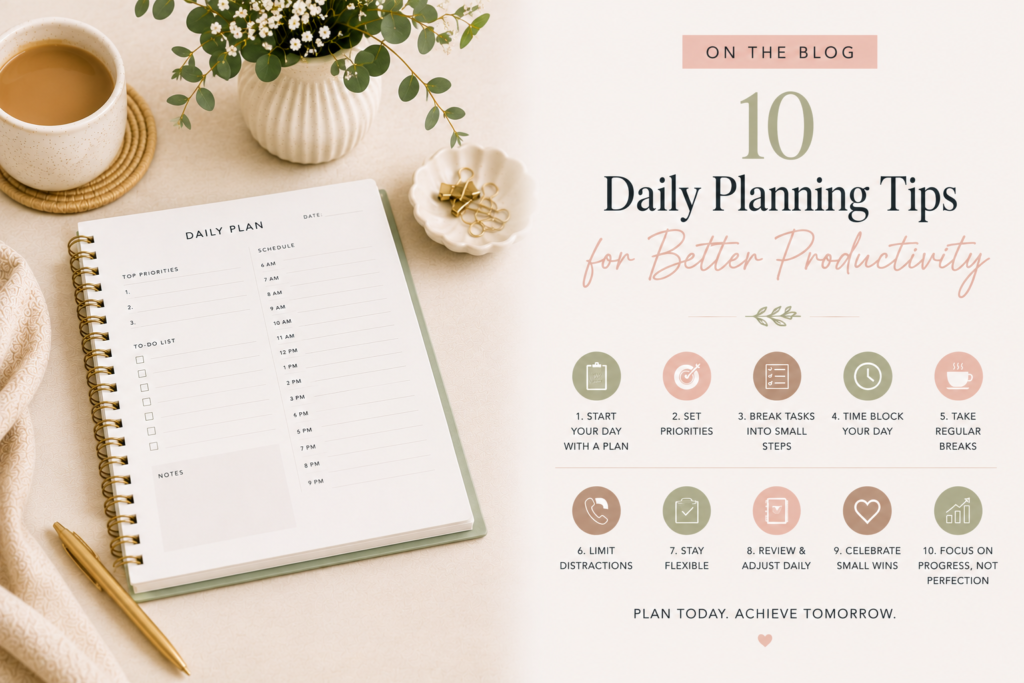
We have all had those days where we feel like we are constantly moving but somehow getting nowhere. The to-do list grows longer by the hour, the inbox refuses to empty itself, and by evening you wonder where the time went. Sound familiar?
The difference between a scattered, stressful day and a focused, fulfilling one rarely comes down to talent or luck. It comes down to how you plan.
Good daily planning is not about packing your schedule so tightly that you cannot breathe. It is about creating a simple structure that helps you show up for the things that actually matter. These ten tips are not theory — they are habits you can start using today, starting from the moment you wake up.
1. Start the Night Before
Here is a truth most people overlook: your most productive days are built the evening before they happen.
Spend just ten minutes before you go to bed writing down your top priorities for the next day. When you know what is coming, your brain quietly works through it while you sleep. You wake up with direction instead of drifting.
Think of it as handing your morning self a head start. No more staring at a blank notepad wondering where to begin.
Try this: Before you close your laptop tonight, write three things you want to accomplish tomorrow. Just three. Put the list somewhere you will see it first thing in the morning.
2. Identify Your One Most Important Task
Productivity is not about doing more things. It is about doing the right things.
Every single day, ask yourself: if I could only complete one thing today, what would make the biggest difference? That is your Most Important Task, or MIT. Schedule it first, protect it fiercely, and build the rest of your day around it.
This single habit can change the way you feel at the end of the day. Instead of finishing exhausted with a half-done list, you finish with something meaningful already behind you.
Try this: Write your MIT at the top of your daily planner or on a sticky note next to your workspace. Make it unmissable.
3. Use Time Blocking Instead of a Simple To-Do List
A to-do list tells you what to do. A time block tells you when you will do it. That difference is everything.
Time blocking means assigning each task or category of work to a specific window in your calendar. For example: deep writing from 9 to 11 in the morning, emails from 11 to 11:30, meetings after lunch. When a task has a time slot, it becomes a commitment rather than a wish.
This method also helps you see whether your expectations are realistic. If you have twelve hours of tasks and only six hours of work time, something has to move. Better to find that out in the morning than at midnight.
Try this: Use Google Calendar, Notion, or even a paper planner to block out tomorrow. Be honest about how long things actually take.
4. Limit Your Daily Priorities to Three to Five
It is tempting to fill an entire page with tasks and feel productive just for writing them all down. But a list of twenty items does not reflect a plan — it reflects anxiety.
Research in cognitive psychology consistently shows that our ability to focus drops sharply when we are juggling too many competing priorities. When everything is important, nothing is.
Pick three to five meaningful tasks each day. Complete those with care and attention. You will feel better about your progress, and the quality of your work will improve too.
Try this: Every morning, use a simple method called the Rule of Three. Write down three things you want done by the end of the day. Finish those before moving to anything else.
5. Build in Buffers Between Tasks
Most people plan their day with zero breathing room. One meeting runs straight into the next. One task bleeds directly into another. And then one small delay makes the entire structure collapse.
Buffers are the glue that holds a real schedule together. Even ten or fifteen minutes between tasks gives you time to finish up, collect your thoughts, and arrive at the next thing without feeling frantic.
Think of buffers not as wasted time but as planned recovery. Athletes rest between sets. Your brain needs the same.
Try this: If a meeting is scheduled for 10 to 11, block your calendar until 11:15. Use that gap to make notes, handle a quick task, or simply breathe.
6. Tackle the Hardest Task First
Mark Twain once wrote about eating a live frog first thing in the morning — the logic being that if you do the worst thing first, everything else that day feels easy. Productivity writers have borrowed this idea and turned it into a useful principle.
Your hardest task is usually the one you keep pushing to the end of the day. That project you have been avoiding. The difficult email you need to send. The report that requires real thinking.
When you do that task first, before distractions build and energy dips, you carry a quiet confidence for the rest of the day. The mental weight lifts immediately.
Try this: Look at your task list and find the one item you are most tempted to defer. Schedule it for the first ninety minutes of your workday tomorrow.
7. Reduce Decision Fatigue with Routines
Every decision you make throughout the day uses a small amount of mental energy. What to eat, what to wear, what to work on next — they all add up. By afternoon, many people are running low on the focused thinking they need for important work.
The solution is to automate as many low-stakes decisions as possible through routine. When parts of your day run on autopilot — morning rituals, meal prep, workout time — you preserve your best thinking for the decisions that genuinely matter.
This is not about being rigid. It is about protecting your mental bandwidth.
Try this: Design a simple morning routine that requires almost no decisions. Same wake-up time, same breakfast, same fifteen minutes of journaling or movement. Notice how your clarity improves.
8. Do a Midday Reset
Most people plan their mornings well and then let their afternoons drift. A midday reset is a short five-minute check-in that keeps you on track for the second half of the day.
Around noon or just after lunch, take out your plan. Ask yourself: what did I get done this morning? What still needs to happen before I finish? Does anything need to shift? This small pause recalibrates your focus and helps you arrive at the afternoon with intention rather than inertia.
It also gives you a moment to celebrate small wins, which matters more than most people realise for staying motivated.
Try this: Set an alarm for 12:30 labelled “midday reset.” Give yourself five minutes to review your plan and adjust if needed.
9. Set a Clear End to Your Workday
Productivity is not just about what you do — it is about what you stop doing and when.
Without a defined end time, work has a way of creeping into evenings and weekends. You might tell yourself you are being productive, but the research suggests otherwise. Chronic overwork diminishes creative thinking, increases mistakes, and eventually leads to burnout.
A clear endpoint creates urgency during work hours and gives your brain genuine rest afterwards. Rest is not laziness. Rest is how you show up better the next day.
Try this: Choose a consistent time to close the laptop and stick to it. Create a small shutdown ritual — review tomorrow’s plan, close your tabs, tidy your workspace. Signal to your brain that work is done.
10. Review and Reflect at the End of Each Week
Daily planning is powerful. Weekly review makes it sustainable.
Once a week — Friday afternoon or Sunday evening works well — take twenty to thirty minutes to look back at the week. What did you accomplish? What fell through and why? Where did your time go that you did not plan for?
This is not about judging yourself. It is about learning. The people who plan consistently well are not people who never get it wrong — they are people who adjust quickly when they do.
A weekly review also helps you spot patterns. Maybe you always over-schedule Mondays. Maybe your afternoons are consistently unproductive. Once you can see those patterns, you can design around them.
Try this: Block thirty minutes every Friday before you log off. Treat it as an unmissable meeting with yourself. Look back, learn something, and walk into the weekend with a clear head.
Pulling It All Together
You do not need a perfect system. You need a consistent one.
Start small. Pick one or two of these tips and build from there. Maybe tonight you write down three priorities for tomorrow. Maybe tomorrow morning you tackle your hardest task first. Little by little, those choices stack up into days that feel different — less chaotic, more intentional, and genuinely more productive.
Planning your day is one of the simplest ways to take back control of your time. And your time, more than anything else, is worth protecting.
Frequently Asked Questions
What is the best way to start planning your day?
Begin the evening before by writing down your three most important tasks. In the morning, review that list before opening your phone or checking email. This sets your intention before distractions take over.
How many tasks should I plan for in a day?
Three to five meaningful tasks is usually the right range. Fewer than three may leave you underutilised; more than five often leads to overwhelm and incomplete work.
What is time blocking and does it actually work?
Time blocking is the practice of assigning specific tasks to specific windows of time in your calendar. It works because it turns intentions into scheduled commitments, reduces the time you spend deciding what to work on next, and makes your available time visible.
How do I stop wasting time during the day?
Identify where your time actually goes by tracking it for a week. Most people are surprised. Once you know your patterns, you can plan specifically around distractions and low-energy periods.
What should a daily planning routine look like?
A solid routine includes an evening review (ten minutes), a focused morning start before checking messages, time-blocked tasks, a midday reset, and a clear shutdown time with a brief shutdown ritual.