
Introduction
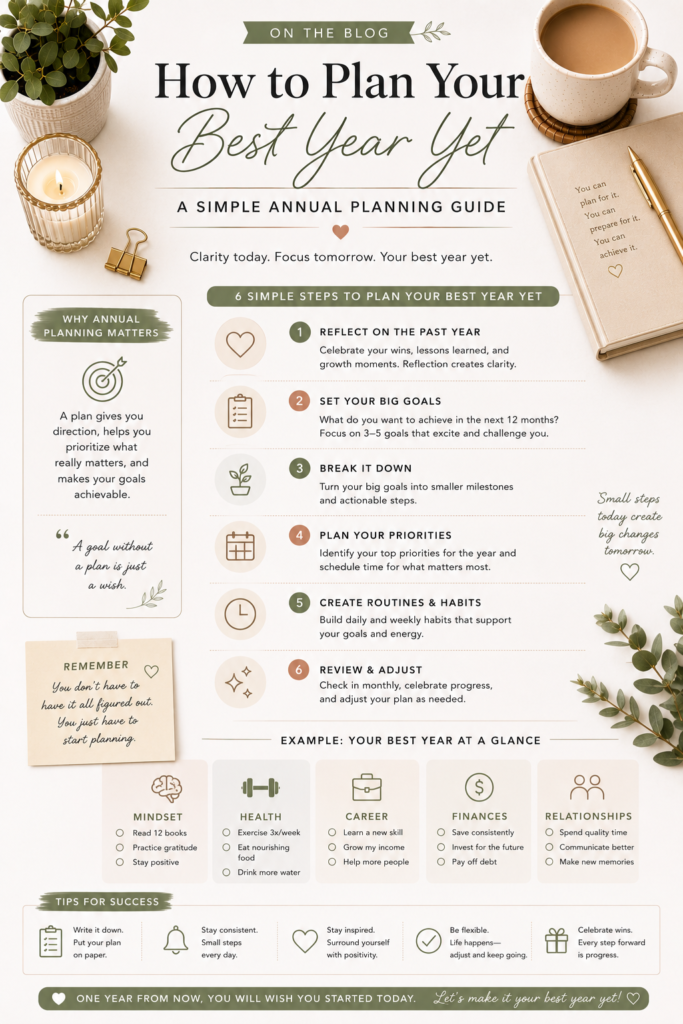
Most people’s relationship with annual planning consists of a single, slightly rushed session sometime in early January — a list of resolutions, a burst of enthusiasm, and by February, only a vague memory of what was actually written down. This is not really a failure of ambition. It is a failure of process. Most annual planning skips the parts that actually make a year intentional, and jumps straight to the part that feels most exciting: the goals themselves.
A genuinely useful annual planning process does something different. It starts by looking backward before looking forward. It builds in checkpoints throughout the year, rather than a single moment of planning in January that is never revisited. And it treats the plan as a living structure to be adjusted, not a fixed prediction to be judged against at year’s end.
This guide lays out exactly that kind of process — one built to actually shape how your year unfolds, not just to produce an aspirational list that quietly fades by spring.
Why a Single January Planning Session Isn’t Enough
Before building a better process, it helps to understand why the typical approach to annual planning so often falls short.
A year is too long a timeframe to plan in detail from a single starting point. So much changes across twelve months — priorities shift, unexpected opportunities and obstacles arise, circumstances evolve — that a plan built entirely in January, with no built-in revisiting, is almost guaranteed to become disconnected from reality well before the year ends.
January carries an unusual, temporary burst of motivation that does not represent the rest of the year. Plans built entirely during this high-motivation window often reflect an idealised version of what you hope to accomplish, rather than a realistic plan grounded in your actual patterns and constraints across a full year, including the inevitable lower-motivation stretches.
Without structured checkpoints, an annual plan has no mechanism for course correction. A plan set once and never revisited cannot adapt to what is actually learned throughout the year. By the time an honest assessment happens — often not until the following December — months of potential adjustment have already been lost.
Annual planning that skips reflection loses valuable information. Looking forward without first looking back means missing the genuine insight that a clear-eyed review of the previous year provides — insight that should meaningfully shape what actually deserves priority in the year ahead.
A better annual planning process addresses each of these gaps directly.
Part 1: The Year-End Review
Before planning the year ahead, spend genuine time reviewing the year that is ending. This step is frequently skipped entirely in favour of jumping straight to new goals, but it is arguably the most valuable part of the entire process.
What Actually Happened This Year
Begin with a simple, honest inventory. What were the significant events, achievements, and challenges of the past year? Resist the urge to filter this too heavily toward only the positive or only the difficult — an accurate picture includes both.
What Am I Proud Of?
Beyond major, obvious achievements, include the smaller things too — habits maintained, difficult conversations had, moments of genuine growth that might not appear on a conventional list of accomplishments. Many people are surprised, once they genuinely reflect, by how much they undervalued in the moment.
What Did Not Go as Planned, and What Did I Learn?
Look honestly at goals or intentions from the past year that did not materialise. Rather than treating this as simple failure, ask specifically what the gap reveals. Was the goal unrealistic? Did priorities genuinely shift? Was there a missing system rather than a lack of desire? This is where the most useful insight for the year ahead often lives.
What Drained My Energy, and What Restored It?
Beyond specific achievements and setbacks, reflect on the underlying patterns of the year. What commitments, relationships, or activities consistently left you depleted? What consistently restored you? This pattern-level reflection often reveals more about what the coming year needs than a list of specific goals alone.
What Am I Ready to Let Go Of?
Not every commitment, relationship, or personal expectation carried from previous years still deserves a place going forward. Part of genuine annual reflection is honestly identifying what no longer serves you, and consciously deciding to release it rather than carrying it forward automatically.
Part 2: Setting Direction for the Year Ahead
With a genuine, honest review complete, turn attention forward. This stage is about establishing direction, not committing to a rigid, unchangeable plan.
Choose a Small Number of Genuine Priorities, Not a Long List
Rather than an extensive list of resolutions across every area of life, identify three to five genuine priorities for the year — areas where you want to see real, meaningful movement. Spreading attention across too many priorities simultaneously tends to produce shallow progress on all of them rather than genuine progress on what matters most.
Consider an Annual Theme, Alongside Specific Goals
Some people find it valuable to choose a single guiding word or theme for the year — a concept like “consolidation,” “expansion,” “depth,” or “rest” — that sits above specific goals and helps guide decisions throughout the year when specific plans do not cover every situation. This is not a replacement for concrete goals but a complementary layer that provides direction even in moments a detailed plan does not anticipate.
Translate Each Priority Into a Specific, Meaningful Goal
For each of your chosen priorities, define what genuine progress would specifically look like by the end of the year. Vague intentions like “improve my health” benefit significantly from being translated into something more specific and measurable, even if the exact target remains somewhat flexible as the year unfolds.
Identify the System Behind Each Goal, Not Just the Goal Itself
As explored in the distinction between goals and systems, an annual goal without a corresponding ongoing process is unlikely to be realised. For each priority, identify not just what you want to achieve, but the specific, repeatable action or habit that will actually carry you toward it across the months ahead.
Part 3: Breaking the Year Into Manageable Chunks
A twelve-month timeframe is genuinely difficult to hold in mind and plan against directly. Breaking the year into smaller segments makes the overall plan considerably more actionable.
Divide Your Annual Priorities Into Quarters
For each of your annual priorities, consider what meaningful progress would look like within each three-month period. This does not need to be a rigid, detailed plan for the full year in advance — often, only the first quarter needs real detail, with later quarters sketched more loosely and refined as you approach them.
Plan in Detail Only for the Quarter Directly Ahead
Rather than attempting to plan every month of the entire year in January, focus detailed planning on the quarter immediately ahead, and revisit this planning process at the start of each subsequent quarter. This keeps your plan genuinely responsive to what you learn and how circumstances evolve throughout the year, rather than committing to overly specific plans many months in advance of the information you will eventually have.
Build in Quarterly Review Sessions
At the end of each quarter, conduct a shorter version of your year-end review process — what progressed, what did not, what needs adjusting for the quarter ahead. This regular rhythm of review and adjustment is what keeps an annual plan connected to reality throughout the year, rather than existing only as an increasingly outdated document from January.
Part 4: Connecting Your Annual Plan to Daily and Weekly Planning
An annual plan that exists only as a distant, yearly document, disconnected from your actual daily and weekly activity, provides direction without traction. The final piece of effective annual planning is ensuring your broader yearly priorities genuinely inform your more immediate planning.
Reference your annual priorities during weekly planning sessions. As part of a regular weekly planning routine, briefly check whether your chosen weekly priorities connect to your broader annual goals, or whether your weeks have drifted toward purely reactive, urgent tasks with no connection to what you identified as genuinely important for the year.
Use your Sunday reset or weekly reflection to maintain awareness of your annual themes. A brief, regular touchpoint — even a glance at your annual priorities written somewhere visible — keeps your yearly direction present in ongoing decision-making, rather than forgotten until the next formal review.
Track progress on annual goals with the same visible, consistent system used for other habits. Whatever tracking approach works for your daily habits — a simple grid, a visible progress marker — apply the same principle to your annual priorities, checked in on monthly or quarterly rather than only once at year’s end.
A Simple Annual Planning Template
Here is a condensed structure bringing this process together, suitable for a dedicated planning session at the end of any year.
Year-End Review:
- Significant events and achievements this year:
- What I am genuinely proud of:
- What did not go as planned, and what I learned:
- What consistently drained my energy:
- What consistently restored my energy:
- What I am ready to let go of:
Year Ahead:
- My theme or guiding word for the year (optional):
- My three to five genuine priorities:
For each priority:
- What specific progress looks like by year’s end:
- The system or habit that will carry me there:
- What this looks like specifically for the quarter directly ahead:
Quarterly Review Dates (mark these now): Q1 review: _____ Q2 review: _____ Q3 review: _____ Q4 review / next year-end review: _____
Common Annual Planning Mistakes
Setting too many priorities. A long list of resolutions divides attention too thinly. Choose fewer priorities and give each genuine, sustained attention across the year.
Planning the entire year in exhaustive detail in January. Detailed planning many months in advance is often wasted effort, since circumstances and priorities shift meaningfully across a full year. Plan the immediate quarter in detail, and the rest more loosely.
Skipping the review process entirely. Jumping straight to new goals without an honest look back loses valuable insight that should genuinely inform what the coming year needs.
Never revisiting the plan after January. An annual plan without built-in quarterly checkpoints becomes disconnected from reality well before the year ends, with no mechanism for correction.
Treating the plan as a fixed prediction rather than a living structure. Circumstances change. A good annual plan is adjusted deliberately as the year unfolds, not abandoned entirely the moment reality diverges from the original plan, nor followed rigidly regardless of what is actually learned along the way.
Using a Dedicated Planner for Annual Planning
Annual planning benefits significantly from a dedicated space that holds your yearly priorities visibly, separate from the day-to-day detail of daily and weekly pages, while still connected to them within the same overall system.
A comprehensive planner that includes an annual overview or goal-setting section, alongside its daily and weekly pages, allows your yearly direction to remain genuinely present throughout the year — referenced during weekly planning sessions, revisited at quarterly checkpoints, rather than written once in January and effectively forgotten. Elabrille’s planner bundles include exactly this kind of annual planning section, designed to connect directly to the weekly and daily pages used throughout the rest of the year, so your broader direction and your daily actions remain genuinely linked rather than existing as separate, disconnected systems.
Pulling It All Together
Planning a genuinely good year is not about predicting the future accurately, or committing in January to a plan that will hold, unchanged, for the following twelve months. It is about starting with an honest look back, choosing a small number of priorities that genuinely matter, breaking those priorities into manageable, immediate steps, and building in regular checkpoints that keep the plan connected to reality as the year actually unfolds.
None of this requires elaborate systems or extraordinary discipline. It requires an honest year-end review, a handful of well-chosen priorities, a system behind each one, and the willingness to revisit and adjust the plan quarterly rather than only once, in January, before setting it aside.
That is genuinely how intentional years are built — not through a single burst of resolution, but through a process designed to hold up across all twelve months.
Frequently Asked Questions
When is the best time to do annual planning?
While the end of December or start of January is the most common time, the specific timing matters less than doing a genuine year-end review before setting new priorities. Some people prefer planning around their birthday, the start of a new season, or another personally meaningful date rather than the calendar year. What matters most is consistency, not the specific date chosen.
How many goals should I set for the year?
Three to five genuine priorities is generally more effective than an extensive list of resolutions. Concentrating attention on a smaller number of meaningful goals tends to produce considerably more real progress than dividing focus across many simultaneous intentions.
What is the difference between an annual theme and an annual goal?
An annual theme is a broader guiding concept or word — such as “consolidation” or “growth” — that helps inform decisions throughout the year, even in situations a specific plan does not directly address. An annual goal is a specific, defined outcome you are working toward. Many people find value in using both together: a theme for overall direction, and specific goals for concrete progress.
What should I do if my annual plan is no longer relevant by mid-year?
This is a normal experience, particularly given how much can genuinely change across twelve months. Use your quarterly review checkpoint to honestly reassess whether your original priorities still reflect what matters most, and adjust deliberately rather than either abandoning planning altogether or rigidly sticking to priorities that no longer serve you.