
Introduction
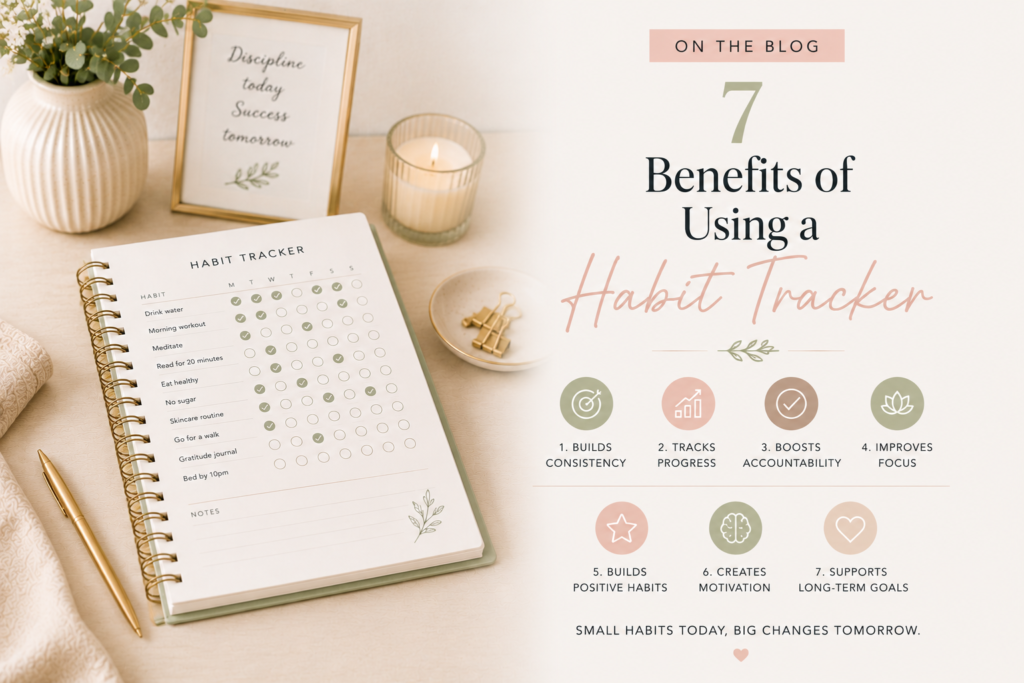
There is a version of yourself that exercises regularly, drinks enough water, reads before bed, and gets things done without constantly fighting your own resistance. That version is not some distant, disciplined stranger. It is simply you — with better habits.
The gap between who you are today and who you want to become is mostly a habits gap. And the fastest way to close that gap is not willpower. It is awareness.
That is exactly what a habit tracker gives you.
A habit tracker is one of the simplest tools in the world — a way of marking whether you did or did not do a specific behaviour on a given day. And yet, despite its simplicity, the effect it has on consistency, motivation, and self-awareness is genuinely remarkable.
If you have ever started a new habit with great enthusiasm only to quietly drop it three weeks later, this is for you. Here are seven real benefits of using a habit tracker, and why so many people swear by them once they finally start.
1. It Makes Your Progress Visible
One of the most underrated reasons habits fade is that progress feels invisible. You go to the gym on Monday and feel no different by Tuesday. You meditate for a week and wonder if anything is actually changing. When effort does not produce immediate, obvious results, motivation quietly drains away.
A habit tracker changes this dynamic completely.
Every time you mark off a completed habit — whether it is a tick, a cross, a filled circle, or a coloured square — you are making your progress visible. You can look at a week or a month and see the accumulated effort laid out in front of you. That is real. That is proof that you showed up.
Psychologists call this a feedback loop. When your brain can see the output of your behaviour, it becomes easier to stay engaged and keep going. The tracker turns abstract effort into something concrete and satisfying.
Over time, those small daily marks add up to something you can genuinely be proud of. A page of completed habits does not just feel good — it shows you exactly who you have been becoming.
2. It Builds Consistency Through the Power of the Streak
James Clear, author of Atomic Habits, describes one of the most powerful motivational effects of habit tracking as “never miss twice.” The idea is simple: missing a habit once is human. Missing it twice starts a new pattern.
A streak — a run of consecutive days where you completed your habit — creates its own momentum. Once you have kept a habit going for five days, ten days, three weeks, breaking the chain starts to feel like a genuine loss. You find yourself doing the habit not just because you want the benefit, but because you do not want to break what you have built.
This might sound like a small psychological trick, but it is one that works remarkably well in practice. The visual streak in your tracker becomes a quiet motivator that keeps pulling you back, even on the days when your enthusiasm is low.
And on the days you do miss? The tracker makes it easy to see and easy to restart. There is no guessing whether you have been consistent. The record is right there, honest and clear.
3. It Increases Self-Awareness
Most people have a fairly inaccurate picture of their own habits. We tend to remember the days we did something right and quietly forget the ones we did not. We tell ourselves we exercise “most weeks” or drink water “pretty consistently” — and genuinely believe it, even when the reality is quite different.
A habit tracker removes the guesswork.
After a month of tracking, you know exactly how often you actually meditated, how many nights you went to bed on time, how frequently you skipped your morning routine. That information is not always comfortable, but it is always useful.
This honest self-awareness is where real change begins. You cannot improve what you cannot measure. And once you can see your actual patterns — not the ones you imagine — you can make smarter decisions about where to focus your energy.
Many people are surprised to find that habits they thought were solid are far more inconsistent than they believed. And sometimes the opposite — you are doing better than you gave yourself credit for. Either way, the truth is more useful than the assumption.
4. It Helps You Build Multiple Habits Without Losing Track
Building one new habit is manageable. Building several at the same time — exercising, journaling, reading, drinking more water, reducing screen time — can quickly become overwhelming without a system to hold it all together.
A habit tracker acts as a single home for all the behaviours you are working on. Instead of carrying a mental checklist through the day and inevitably forgetting something, you have everything in one place, waiting to be ticked off.
This is particularly useful in the early stages of habit formation, when new behaviours are not yet automatic. The tracker serves as a daily prompt — a gentle reminder of what you intended to do and whether you have done it yet.
It also reveals when you are trying to change too much at once. If you have twelve habits listed and you are consistently completing only four of them, that is valuable information. You can scale back, focus on what matters most, and give each habit the attention it needs to actually take root.
5. It Gives You a Sense of Control Over Your Day
There is something quietly powerful about starting your day knowing what you intend to do and ending it with evidence that you did it.
In a world full of unexpected demands, constant notifications, and tasks that seem to multiply overnight, a habit tracker gives you a small but meaningful pocket of structure. These are the things you chose to do. These are the behaviours that reflect your values and your goals. Whether the rest of the day went to plan or not, these things were in your hands.
That sense of agency matters more than it might seem. Research in psychology consistently links a sense of personal control to higher motivation, lower stress, and greater wellbeing. When you feel like you are steering your own life — even in small ways — you show up differently.
A habit tracker will not fix a chaotic schedule or solve every productivity problem. But it can anchor your day in something solid: the deliberate choices you made for yourself, one tick at a time.
6. It Reveals Patterns You Would Never Notice Otherwise
After several weeks of consistent tracking, something interesting happens. Patterns begin to emerge that you simply would not have spotted without a record.
Maybe you notice that you exercise reliably on weekdays but almost never on weekends. Maybe your journaling habit holds perfectly well in the mornings but falls apart when you have an early meeting. Maybe your water intake drops sharply on high-stress days.
These patterns are gold.
Once you can see them, you can design around them. You can move a habit to a time of day when you actually have the energy for it. You can pair a fragile habit with a stronger one so it gets carried along. You can identify which specific circumstances knock your habits off course and plan for them in advance.
Without the tracker, these patterns remain invisible. You just know that some weeks go well and others do not, without ever understanding why. The data your tracker collects — even something as simple as a grid of ticks and blanks — gives you a map of your own behaviour that you can actually work with.
7. It Makes Small Wins Feel Real
Here is something most productivity advice does not say loudly enough: small wins matter enormously.
Not because they produce big results immediately — but because they keep you moving. The brain responds to completion. Finishing something, even something small, releases a little dopamine. That small chemical reward makes you more likely to do it again tomorrow. Stack enough of those small rewards together and you have built a genuine habit.
A habit tracker amplifies this effect. Every tick is a mini-completion. Every completed row is a small win. Every full week of consistency is a moment worth acknowledging.
This is especially important in the early stages of building a habit, when the real benefits — better health, improved focus, greater calm — have not yet fully arrived. The tracker gives you something to feel good about right now, before the long-term results show up. And that early positive reinforcement is often exactly what keeps people going long enough to see those results.
Do not underestimate the motivational power of crossing something off. It is small. It is simple. And it works.
What to Track and What to Leave Out
Not every behaviour deserves a place in your habit tracker printable. Trying to track too many things at once is one of the fastest ways to abandon the system altogether.
A good rule of thumb is to track only the habits you are actively trying to build or maintain. These are behaviours you have consciously chosen to prioritise — not everything you do in a day.
Good candidates for tracking include:
- Exercise or movement (even a short daily walk counts)
- Hydration — a surprisingly easy one to neglect
- Sleep and wind-down routines
- Reading, journaling, or learning
- Mindfulness or meditation
- Creative work or a personal project you want to keep momentum on
Leave out habits that are already fully automatic. You do not need to track whether you brushed your teeth — you have done that without thinking for years. Save your tracker for the behaviours that still need conscious attention and gentle encouragement.
Also, resist the urge to redesign your tracker every few weeks. Consistency in the system matters as much as consistency in the habits.
Paper Tracker or Digital App — Which Should You Choose?
Both work. The one you will actually use consistently is the right answer.
A paper habit tracker — whether in a bullet journal, a printed template, or a dedicated planner — is tactile and satisfying. Writing by hand tends to feel more intentional. There are no notifications pulling you elsewhere, and the physical act of marking a habit off can feel genuinely rewarding in a way that tapping a screen does not always replicate.
Digital habit trackers like Habitica, Streaks, or the habit tracker built into many planning apps offer reminders, analytics, and the convenience of always being in your pocket. If you are someone who lives on your phone and tends to forget paper tools, a digital tracker might be the more honest choice.
Some people keep a paper tracker for their personal habits and a digital one for work-related behaviours, or use a weekly planner that includes a built-in habit grid. There is no rule — only what works for you.
The most important thing is to keep the tracker somewhere you will see it every single day. A tracker you have to hunt for is a tracker you will not use.
How to Start Your Habit Tracker Today
You do not need a perfect system to begin. Here is a simple way to start right now:
Step one: Choose two or three habits you genuinely want to build. Start small. Ambitious lists are exciting to write and hard to keep.
Step two: Set up a simple grid — dates along the top, habits down the side. Paper, spreadsheet, app — whatever you have.
Step three: At the end of each day, mark what you did. Keep it simple: a tick for done, a blank or cross for not done.
Step four: At the end of the first week, look at your grid honestly. What held? What did not? Adjust your approach, not your ambitions.
Step five: Keep going for at least thirty days before judging whether it is working. Habits take time to form and trackers take time to become habits in themselves.
That is genuinely all there is to it. The power is not in the tool — it is in the act of showing up, day after day, and leaving a record that you did.
Pulling It All Together
A habit tracker will not transform your life overnight. Nothing will. But it will do something just as valuable — it will show you, clearly and honestly, whether you are living in alignment with who you are trying to become.
It makes progress visible when it would otherwise feel invisible. It builds streaks that pull you forward on low-motivation days. It reveals patterns that help you plan smarter. And it turns every small completed action into something worth acknowledging.
The habits you build today are the life you live tomorrow. A tracker is simply a way of taking that seriously, one day at a time.
Frequently Asked Questions
What is a habit tracker and how does it work?
A habit tracker is a simple tool — digital or paper — that records whether you completed a specific behaviour on a given day. You list the habits you want to build, then mark each one daily. Over time, the record reveals your patterns and progress in a way that memory alone cannot.
How many habits should I track at once?
Start with two to five habits. More than that tends to become overwhelming, especially when you are still establishing the tracking routine itself. Once those habits feel solid, you can add more.
Do habit trackers actually work?
For most people, yes — particularly because they increase awareness and make progress visible. Research on self-monitoring consistently shows that people who track their behaviours are more likely to maintain them. That said, a tracker is a tool, not magic. It works best when combined with clear intentions and realistic expectations.
What is the best habit tracker app?
Popular options include Habitica, Streaks (iOS), Habit — Daily Tracker, and the habit features built into apps like Notion or Sunsama. The best one is the one you will open every day. Try one for two weeks before switching — consistency matters more than features.
How long does it take to build a habit?
The commonly cited figure of twenty-one days is a myth. Research from University College London found that on average it takes around sixty-six days for a behaviour to become automatic — though this varies widely depending on the habit and the person. This is exactly why a habit tracker matters: it helps you stay consistent long enough for the habit to actually stick.