
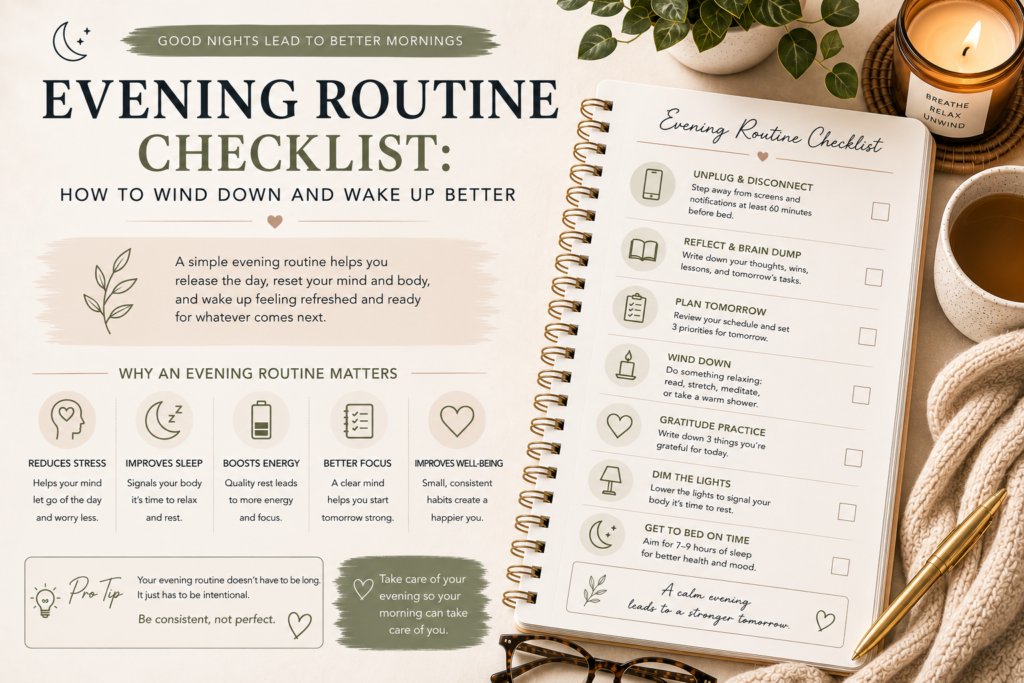
Most conversations about productive mornings skip over an inconvenient truth: a genuinely good morning is decided the night before, not the moment you wake up. The quality of your sleep, how prepared tomorrow feels, and how calm or scattered your mind is when your head hits the pillow all shape the morning that follows, often more powerfully than anything you do after waking.
An evening routine is not simply the mirror image of a morning routine. It serves a genuinely different purpose: winding down a nervous system that has likely been active and engaged all day, preparing your environment and your mind for both restful sleep and a smoother following morning, and creating a clear, deliberate boundary between the demands of the day and genuine rest.
This guide provides a complete evening routine checklist, along with the reasoning behind each element, so you can build a routine that genuinely fits your life rather than following a rigid template that does not reflect your actual evenings.
Why an Evening Routine Matters as Much as a Morning One
Sleep quality is shaped significantly by what happens in the hour or two beforehand. The transition into sleep is not instantaneous — it is a gradual process that responds strongly to environmental and behavioural cues. A consistent, calming evening routine signals to your body that sleep is approaching, supporting an easier, more genuine transition than an abrupt shift from high engagement directly into attempting sleep.
An unprepared morning often originates in an unprepared evening. Many of the small frictions that make mornings feel rushed and stressful — searching for items, deciding what to wear, uncertainty about the day ahead — can be addressed the night before, when there is genuinely more time and mental bandwidth available than during a groggy, time-pressured morning.
Evening is when unresolved mental clutter from the day tends to surface most strongly. Without a deliberate process for addressing this, racing thoughts and unresolved concerns can significantly interfere with falling asleep, extending the time it genuinely takes to drift off even when physical tiredness is present.
A clear boundary between “day” and “rest” supports genuine psychological recovery. Without any deliberate transition, work and daily demands can bleed directly into what should be restorative time, reducing the quality of rest even when the total hours technically available for it remain unchanged.
The Complete Evening Routine Checklist
1. Set a Consistent Wind-Down Start Time
Choose a specific time, roughly forty-five minutes to an hour before your intended sleep time, when your evening routine deliberately begins. A consistent start time, much like a consistent wake time, supports your body’s natural rhythm considerably more effectively than an evening routine that begins at a different time each night.
2. Reduce Screen Brightness and Content Stimulation
In the hour before intended sleep, dim screens where possible, and consider shifting away from highly stimulating content — intense news, work-related messages, emotionally activating social media — toward calmer alternatives. Blue light exposure and cognitively or emotionally activating content both appear to interfere with the natural process of winding down.
3. Do a Brief Brain Dump of Anything Unresolved
Spend five to ten minutes writing down anything currently occupying mental space — tasks, worries, things you keep thinking about. This externalisation tends to reduce the racing thoughts that otherwise interfere with falling asleep, by giving unresolved mental content somewhere reliable to exist outside your own memory.
4. Prepare Tomorrow’s Essentials
Lay out clothes, prepare anything needed for the next day, pack a bag if relevant. This single step removes numerous small morning decisions and frictions, freeing your groggier morning self from needing to make choices your more capable evening self can handle instead.
5. Review Tomorrow’s Schedule and Set Your Top Priority
Spend a few minutes looking at what tomorrow holds — any fixed commitments, and what you consider the single most important task. This brief review reduces the uncertainty that otherwise contributes to Sunday-evening-style anxiety on any night of the week, and means you wake with direction rather than needing to figure out the day from scratch.
6. Tidy Your Immediate Environment Briefly
A short, five to ten minute tidy of your immediate living space — particularly areas you will interact with first thing in the morning — reduces the small visual clutter that can quietly contribute to a less calm start to the following day.
7. Engage in a Genuinely Calming, Non-Work Activity
Whether reading, a warm bath, gentle stretching, or quiet time with a partner or pet, include something specifically chosen because it feels calming and enjoyable, distinct from anything task-oriented or work-related. This is not the moment for a productivity task disguised as relaxation.
8. Address Any Caffeine or Stimulant Timing Issues
If sleep quality has been inconsistent, review your caffeine intake timing specifically. Caffeine has a longer half-life than many people assume, and afternoon or early evening consumption can measurably affect sleep quality even without a conscious feeling of being kept awake by it.
9. Create a Consistent Final Signal That the Day Is Complete
A specific, consistent final action — turning off a particular light, a brief moment of gratitude reflection, closing your planner for the day — provides a clear, deliberate marker that the day has genuinely concluded, supporting the psychological transition into rest.
10. Protect a Consistent Sleep Time
While not strictly part of the routine itself, aiming for a consistent time to actually attempt sleep, following your wind-down routine, supports the same circadian rhythm benefits that a consistent wake time provides.
Building Your Own Evening Routine From This Checklist
Not every element needs to be included every night, and attempting all ten simultaneously from the start is likely to feel overwhelming rather than genuinely restful.
Start with two or three elements that address your specific, current challenges. If mornings feel consistently rushed, prioritise preparing tomorrow’s essentials and reviewing your schedule. If falling asleep feels difficult, prioritise the brain dump and reduced screen stimulation. Choose based on what would genuinely help your specific situation, rather than attempting the complete checklist immediately.
Sequence your chosen elements in a consistent order. A predictable sequence — even a short one — helps your body and mind learn to anticipate what comes next, strengthening the routine’s effectiveness as a genuine wind-down cue over time.
Keep the total routine realistically short, particularly at the start. A routine of fifteen to twenty minutes, consistently followed, provides more genuine benefit than an elaborate forty-five-minute routine that feels burdensome and gets skipped on tired nights.
Expand gradually as the shorter version becomes genuinely automatic. Once your initial routine feels established and easy to maintain, adding further elements from the checklist becomes considerably more sustainable than attempting the full list from the outset.
Adjusting Your Evening Routine for Different Circumstances
If you have young children, your evening routine may need to happen in whatever window exists after their bedtime, potentially compressed into a shorter timeframe than an idealised routine would suggest. A five-minute version, focused on your single highest-priority element, is genuinely valuable even within significant time constraints.
If you work irregular or shift-based hours, the specific timing of your evening routine should shift to align with your actual sleep schedule, rather than a conventional evening timeframe that does not match your genuine rhythm. The principles remain the same; the clock time simply moves.
If you live with a partner or others, consider which elements of your evening routine benefit from being shared and which genuinely require individual, quiet time. Both are legitimate, and an evening routine can reasonably include both shared and individual components.
If your evenings are genuinely unpredictable, focus on the elements of the checklist that are most portable and least dependent on a specific, quiet environment — a brief brain dump and setting tomorrow’s priority can often happen even amid a chaotic evening, providing some benefit even when a full, calm routine is not realistic that particular night.
Common Evening Routine Mistakes
Treating screen time reduction as all-or-nothing, then abandoning the entire attempt when it feels too restrictive. A more gradual reduction — even simply lowering brightness and avoiding the most stimulating content, rather than eliminating screens entirely — provides real benefit without requiring an unsustainable, complete elimination.
Turning a calming activity into another task to optimise. Reading a book you feel obligated to finish for self-improvement purposes, or exercising with performance goals in mind, can undermine the genuinely calming, non-demanding quality an evening routine’s relaxation element is meant to provide.
Starting the routine too late to actually provide a meaningful wind-down period. A routine begun only minutes before attempting sleep does not provide sufficient time for the gradual transition that supports genuinely restful sleep onset.
Being inconsistent with timing, undermining the circadian rhythm benefits a routine can otherwise provide. An evening routine that happens at a significantly different time each night provides less benefit than a shorter but more consistently timed routine.
Using a Physical Checklist for Your Evening Routine
A simple, visible checklist — whether a printed page or a dedicated section within a daily planner — removes the need to remember your chosen evening routine elements from memory each night, particularly valuable during the tired, lower-cognitive-capacity hours when an evening routine typically happens. Marking off each completed element also provides a small, satisfying sense of closure to the day. Elabrille’s daily planner pages include an evening routine and reflection section designed specifically to support this kind of consistent, checklist-based wind-down practice.
Pulling It All Together
An evening routine, built around winding down your nervous system, preparing your practical environment, and creating a clear boundary between the day’s demands and genuine rest, sets up both better sleep and a smoother following morning.
Choose two or three elements from this checklist that address your specific current challenges. Keep your routine realistically short at the start. Sequence it consistently, and expand gradually as it becomes genuinely automatic. The version of tomorrow morning that feels calm and prepared, rather than rushed and reactive, begins with what you choose to do tonight.
Frequently Asked Questions
What should be included in a good evening routine?
A well-rounded evening routine typically includes reduced screen stimulation, a brief brain dump of unresolved thoughts, preparation of tomorrow’s essentials, a review of tomorrow’s schedule and top priority, a genuinely calming non-work activity, and a consistent final signal marking the day’s completion.
How long should an evening wind-down routine be?
Fifteen to twenty minutes is a realistic, sustainable length for most people, particularly when starting a new routine.
Why does reducing screen time before bed actually help with sleep?
Blue light exposure from screens can interfere with the body’s natural melatonin production, while stimulating or emotionally activating content can keep your mind alert rather than winding down. Both effects work against the gradual physiological and psychological transition that supports restful sleep onset.
What if I don’t have much free time in the evening for a routine?
Focus on the elements that provide the most benefit relative to time invested — even a five-minute version covering a brief brain dump and setting tomorrow’s top priority provides genuine value. The routine does not need to be elaborate to be worthwhile; consistency with a shorter version matters more than attempting a lengthy routine you cannot sustain.
Can an evening routine help if I struggle with racing thoughts at night?
Yes — a brief brain dump specifically addressing unresolved thoughts and worries, done as part of your evening routine, tends to reduce the mental rumination that often interferes with falling asleep. Externalising these thoughts onto paper, rather than leaving them to circulate unresolved, is one of the more effective elements for this specific challenge.