
Introduction
You already know which habits would improve your life. You have known for a while.
More sleep. Less scrolling. Regular exercise. Drinking enough water. Reading instead of watching. Planning your day before it plans you. None of these are secrets. The information is not the problem.
The problem is the gap between knowing what to do and actually doing it — consistently, past the first flush of motivation, through the difficult weeks when everything feels harder than it should.
That gap is not a character flaw. It is not evidence that you are lazy or undisciplined or simply not the kind of person who sticks to things. It is a design problem. And design problems have design solutions.
This guide is about the practical side of habit building — the specific things you can do, starting today, to make better habits easier to start, easier to maintain, and far more likely to survive the inevitable rough patches. Less theory, more action. Let us get into it.
Start With Honesty About Where You Actually Are
Before you build anything, you need an accurate foundation to build on.
Most people begin a new habit from an imagined version of their life — the version where they have more time, more energy, and more willpower than they currently do. They design a habit for their ideal self and then wonder why their actual self cannot keep up.
Spend five minutes before you start any new habit answering these three questions honestly:
When do I actually have time for this? Not when you wish you had time. When do you genuinely have a consistent window — even a small one — that this habit could fit into without requiring a complete restructure of your day?
What is my realistic energy level at that time? A habit that requires focused cognitive effort at 9pm when you are exhausted after a full day is going to fail. Be honest about when your energy is genuinely available, not just when the time slot looks neat on paper.
What has stopped me from building this habit before? If you have tried and failed at this particular habit previously, the reason matters. Was it the wrong time of day? Too ambitious a target? No clear trigger? The same obstacles tend to reappear until you address them specifically.
This honest baseline is not discouraging — it is freeing. You are not designing for an imaginary version of yourself. You are designing for the real one, and that makes success significantly more likely.
Choose One Habit at a Time
There is a version of habit building that looks like: new morning routine, daily exercise, no sugar, read thirty minutes a night, meditate, journal, drink three litres of water, and go to bed by 10pm — all starting on the first of the month.
This approach almost always fails. Not because the goals are wrong, but because building a habit requires genuine cognitive attention in the early stages. Your brain is forming new neural pathways, resisting old defaults, and learning to associate a new cue with a new behaviour. That process takes focus.
Divide that focus across six simultaneous habits and none of them gets enough. They all feel effortful indefinitely, none ever become truly automatic, and the whole system collapses under its own weight around week three.
One habit at a time is not slow. It is the fastest route to a genuinely changed life. Choose the habit that matters most right now — or the one that would make the others easier. Focus on it for four to six weeks until it feels like a natural part of your day. Then add the next one.
The discipline required to choose one thing and ignore the rest is harder than it sounds. It is also far more powerful than trying to change everything at once.
Make the Habit So Small It Seems Pointless
This principle is counterintuitive enough that most people resist it the first time they hear it. It works anyway.
Whatever habit you want to build, start with a version so small that it almost seems not worth doing. Two minutes of meditation. Five push-ups. One page of reading. A single sentence in your journal. A glass of water first thing in the morning.
The size of the starting habit is almost irrelevant. What matters is the act of showing up — reliably, consistently, at the same time, triggered by the same cue — until the behaviour becomes automatic. Once it is automatic, expanding it is easy. Growing a habit that exists is straightforward. Creating a habit from scratch is the hard part.
There is also something important that happens when you make a habit tiny: you remove the psychological resistance that gets in the way of starting. A five-minute run does not require motivation. You do not need to feel inspired, energised, or ready. You just put your shoes on and go. And once you are moving, continuing feels natural.
Most people abandon habits not during the habit itself, but at the decision point just before it. A tiny habit makes that decision point nearly frictionless.
Give Every Habit a Specific When and Where
Vague intentions produce vague results.
“I want to exercise more” is an intention. “I will do ten minutes of exercise in my living room immediately after I drop the kids at school, Monday through Friday” is a habit plan. One of these will produce behaviour change. The other will produce guilt.
Researchers call this an implementation intention — a specific plan that states exactly when and where a behaviour will happen. Study after study shows that people who form implementation intentions are significantly more likely to follow through than those who set goals without specifying the when and where.
The reason is simple: a specific trigger removes the need for an in-the-moment decision. When you decide in advance that the habit happens after a specific event, at a specific time, in a specific location, the decision has already been made. You just execute.
Write your implementation intention down. Make it as specific as possible. “Every morning after I pour my first coffee, I will sit at my desk and write three things I am grateful for before I open my email.” That level of specificity is what bridges the gap between intention and action.
Stack Your New Habit Onto an Existing One
You already have dozens of habits running automatically every day. Getting dressed, making coffee, brushing your teeth, checking your phone, sitting down at your desk. These habits happen without conscious decision because they are deeply grooved into your daily routine.
Habit stacking means deliberately attaching a new habit to one of these existing anchors. The formula is: after I do [established habit], I will do [new habit].
After I pour my morning coffee → I will write my three priorities for the day. After I sit down at my desk → I will spend two minutes reviewing my weekly plan. After I brush my teeth at night → I will read for ten minutes. After I finish lunch → I will take a ten-minute walk.
The existing habit acts as a built-in reminder — a cue that fires reliably every day without any effort on your part. The new habit rides on its coat-tails. Over time, the connection between the two behaviours strengthens until the new one feels as automatic as the anchor it is attached to.
When choosing your anchor habit, pick one that is genuinely consistent — something you do at roughly the same time, in the same place, every single day. The more reliable the anchor, the more reliable the new habit it carries.
Remove Every Obstacle You Can Think Of
You have decided to exercise in the mornings. The night before, you need to find your gym kit, fill your water bottle, check where you put your headphones, and decide what you are going to do when you get there. By the time you have done all of that at 6am on a Tuesday, the appeal of staying in bed has won.
Friction — the small obstacles and inconveniences between you and a behaviour — has an outsized effect on whether habits actually happen. We like to think our choices come from values and intentions. They come at least as much from what is easy versus what is difficult.
The solution is to reduce friction for the habits you want, and deliberately increase it for the behaviours you want to reduce.
For good habits: prepare everything in advance. Lay out your gym clothes the night before. Leave your journal open on your desk. Keep your water bottle full and in sight. Set up your workspace so starting your most important work requires one step, not five.
For habits you are trying to break: make them harder to access. Delete social media from your home screen so you have to search for it. Move the biscuits to the back of the cupboard. Put your phone charger in a different room from your bed. Every extra step between you and an unwanted behaviour is a step that might interrupt the impulse long enough for a better choice.
You are not relying on willpower. You are designing a day where good choices are the path of least resistance.
Track Your Habits Where You Can See Them
A habit you track is a habit you take seriously.
There is something about making your behaviour visible — marking a tick, filling a square, extending a streak — that changes your relationship to it. The habit stops being something you vaguely intend to do and becomes something you are accountable to. The record is there. The streak is real. Breaking it means something.
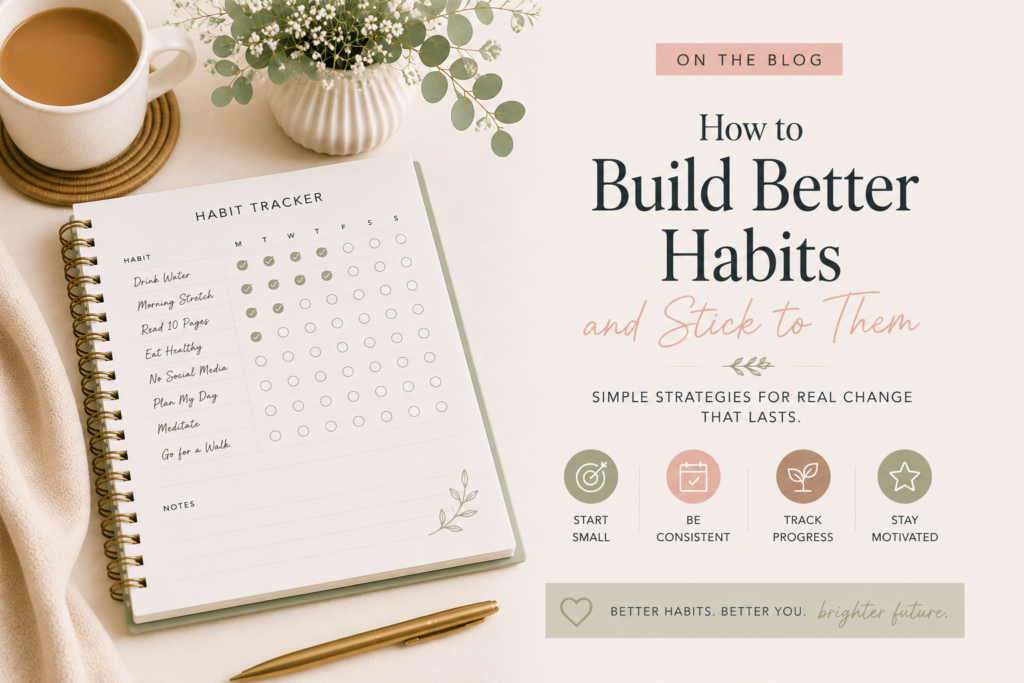
The simplest possible habit tracker is a grid. Dates along the top, habits down the side, a mark for each day you complete each one. You do not need an app. You do not need a beautiful, colour-coded spread. You need something you will look at every day and update honestly.
What the tracker does, beyond the motivational effect, is give you accurate information. After a month, you will know exactly how consistent you actually are — not how consistent you imagine yourself to be. That data is useful. The days you consistently skip reveal something worth knowing about timing, energy, or friction. The habits you complete reliably tell you which ones are genuinely working.
Use a habit tracker in your planner, a simple printed template, or an app — whichever you will open every day. The tool matters far less than the consistency of using it.
Build in a Reward That Happens Immediately
Here is the challenge with most good habits: the real reward arrives far in the future. You exercise today for a body that is healthier in six months. You save money today for security you will not feel for years. You sleep early tonight for energy you might not even attribute to last night’s sleep tomorrow morning.
The human brain is not well-designed for this kind of delayed gratification. It is wired to respond strongly to immediate consequences and to discount future ones heavily. This is not weakness — it is evolution. But it does mean that habits with only distant rewards are genuinely harder to maintain than habits with immediate ones.
The practical solution is to attach an immediate reward to the habit — something small and genuinely enjoyable that happens right after the behaviour, every time.
This might be a specific podcast or playlist you only listen to during your morning walk. It might be a cup of your favourite tea that you make only after completing your journaling. It might be the satisfying ritual of marking your habit tracker — which is itself a small but real reward. It might be five minutes of something you enjoy doing as a direct follow-up to a habit you find difficult.
The reward does not need to be grand. It needs to be immediate, consistent, and genuinely pleasant. Over time, the brain begins to anticipate the reward when it detects the cue, which creates a pull toward the habit that feels increasingly natural.
Expect the Dip and Plan for It
There is a predictable pattern in habit building that almost everyone experiences and almost no one plans for.
Week one: motivation is high, the habit feels exciting and new, showing up is relatively easy. Week two: novelty is fading but habit is not yet automatic, effort is required, some days feel like a grind. Week three: this is the danger zone. The initial enthusiasm is gone. The habit is not yet deeply grooved. The reasons to skip multiply and the reasons to continue feel abstract. This is where most habits die.
Knowing this pattern exists means you can plan for it. Instead of being blindsided by the dip in week three and concluding that the habit is not working or that you are not the right kind of person for it, you can recognise it for what it is: a predictable phase that everyone goes through, which passes if you stay the course.
Reduce expectations during the dip. Do the tiny version of the habit. Two minutes of meditation instead of ten. A short walk instead of a full workout. One paragraph instead of a full writing session. The goal during the dip is not performance. It is continuity. Keeping the thread of the habit alive until it begins to feel automatic on the other side.
Never Miss Twice
You will miss days. Accept this now, before it happens, so it does not derail you when it does.
Illness, travel, crises, exhaustion, a day that simply went differently than planned — these are not exceptions to a well-lived life. They are the texture of it. Any realistic approach to habit building has to account for them.
The rule is simple and worth tattooing on the inside of your eyelids: never miss twice.
Missing a habit once has virtually no measurable impact on long-term success. The habit is not gone. The streak is broken, yes, but the underlying pattern is still there. What matters is what you do on day two after a miss.
If you miss Monday and you miss Tuesday, you are not just two days behind. You are actively beginning a new pattern — the pattern of not doing this thing. Three misses and that pattern starts to feel like the default again. The old behaviour reasserts itself.
Come back the next day. Not with extra effort or self-punishment. Not with a vow to make up for lost time. Simply return to the habit as if yesterday’s miss were a neutral fact rather than a personal failure. Because that is all it is.
Find Accountability That Works for You
There is strong evidence across multiple fields — fitness, finances, work, health — that telling another person about your commitment significantly increases follow-through. This is not just anecdotal. The social dimension of habit building is real and powerful.
Accountability can take many forms, and the right one depends on your personality.
For some people, a dedicated accountability partner — someone who is working on their own habits and who checks in with you weekly — is the most powerful motivator. Knowing that someone is going to ask whether you showed up makes it harder to skip.
For others, public commitment works well. Sharing a goal on social media, joining a community of people with similar habits, or simply telling a friend what you are working on creates a mild social pressure that reinforces follow-through.
For highly independent people who find external accountability more stressful than helpful, a private written commitment can serve a similar function. A letter to yourself about why this habit matters. A journal entry that you return to on difficult days. A clear written statement of who you are becoming and what that person does every day.
Choose the form that fits you. The specific mechanism matters less than the fact of making your commitment real to something beyond just your own in-the-moment feelings.
Review and Adjust Regularly
The habit you designed at the beginning of the month may need adjusting by the end of it. That is not failure — it is information.
A brief weekly review of your habits — five minutes during your weekly planning session — tells you what is working and what is not. Which habits are you completing consistently? Which ones are you regularly skipping, and at what point in the day? Which ones feel genuinely integrated into your routine, and which ones still feel like an effort every time?
Use what you learn. If a habit consistently fails at a particular time, try a different time. If you are regularly skipping a habit because the version you set is too ambitious, scale it back without shame. If a habit that felt important at the start of the month no longer seems worth the space it takes in your day, let it go and choose something better.
Good habit building is iterative. The version you start with is rarely the version you end up with. What you are building is not a perfect, fixed routine — it is a living system that evolves with you and grows increasingly well-suited to how you actually live.
When Multiple Habits Start Feeling Natural
There comes a point, different for every person and every habit, where showing up stops requiring a conscious decision. You just do it. The cue fires, the routine follows, and the reward arrives — all with very little friction or deliberation.
This is what automatic behaviour feels like. It is the goal. And when one habit reaches this point, the next one becomes easier to add — not just because you have more bandwidth, but because your identity is shifting.
You are becoming someone who plans their day. Someone who moves their body. Someone who reads before bed. Someone who takes their commitments seriously. Each completed habit casts a small vote for that identity, and over time those votes accumulate into a self-image that makes the next good habit feel natural rather than forced.
This is the real long-term payoff of habit building — not any individual behaviour in isolation, but the slow, steady process of becoming a person whose defaults are good ones.
Pulling It All Together
Building better habits and sticking to them is not a matter of trying harder. It is a matter of designing smarter.
Start with honesty about where you actually are. Choose one habit and make it tiny. Give it a specific time and trigger. Stack it onto something you already do. Remove the friction that stands between you and doing it. Track it where you can see it. Build in an immediate reward. Expect the dip, plan for it, and come back after you miss a day.
None of these steps is complicated. Together, they create the conditions under which habits do not just start — they last.
The version of yourself with better habits is not waiting for a motivational breakthrough or a perfect moment to begin. They are built in the ordinary moments, the quiet mornings, the unremarkable Tuesday evenings when you did the thing anyway.
Start small. Start today. And keep going.
Frequently Asked Questions
What is the most effective way to build a new habit?
The most effective approach combines four elements: a clear, specific trigger that cues the behaviour; a version of the habit small enough to do even on difficult days; an immediate reward that follows the behaviour; and visible tracking that makes your progress real. Together these cover the full habit loop and dramatically improve the odds of the behaviour becoming automatic.
How long does it take for a habit to feel automatic?
Research from University College London suggests an average of sixty-six days, though the range is wide — from eighteen days for very simple habits to over two hundred for more complex ones. The key variable is consistency. A habit practised imperfectly every day develops faster than one done perfectly twice a week.
Is it better to build habits in the morning or evening?
Neither is universally better. The right time is the one where you have consistent energy, consistent availability, and a reliable trigger to attach the habit to. Morning habits benefit from fewer competing demands and the fact that decision fatigue has not yet set in. Evening habits benefit from the day’s work being done and can serve as a wind-down ritual. Experiment and let your results guide you.
What should I do if I keep failing at the same habit?
Treat repeated failure as useful data rather than personal evidence. Ask specifically: what is the obstacle? Is the habit too large? Happening at the wrong time? Lacking a clear trigger? Too much friction in the environment? Missing an immediate reward? Most habit failures have a specific, fixable cause. Identify it, change one variable, and try again. The answer is almost never “try harder” — it is “design differently.”