
Introduction
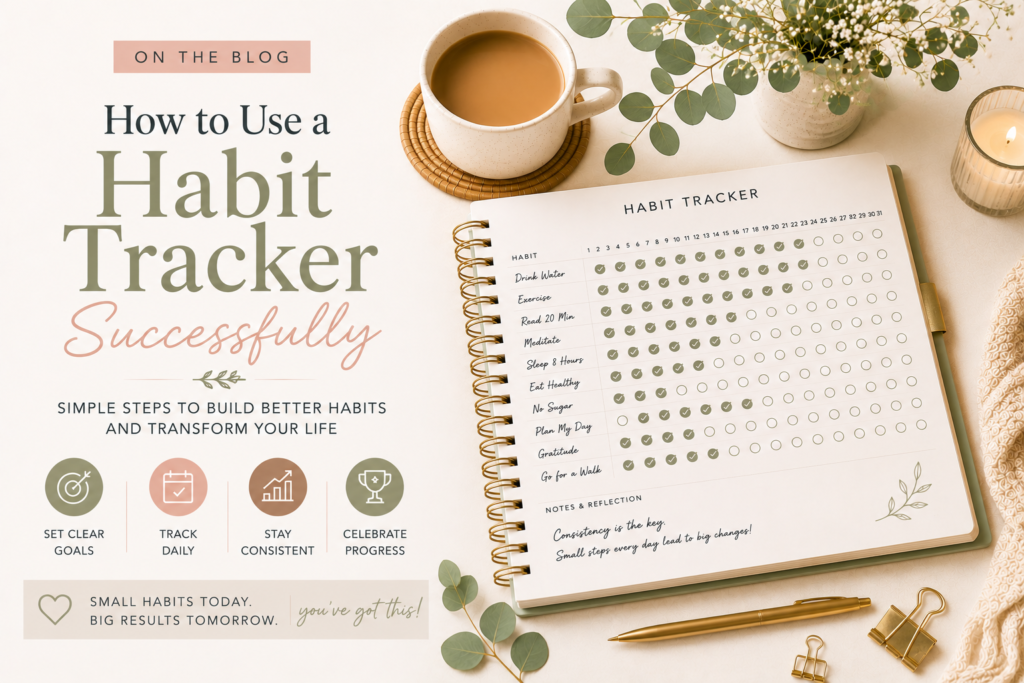
A habit tracker is one of the simplest tools available for building consistency — a grid, a pen, and a mark for each day you follow through. And yet a surprising number of people buy or print a beautiful habit tracker, use it enthusiastically for a week or two, and then quietly stop, not because the tool does not work, but because they were never quite sure how to use it properly in the first place.
This is a genuinely common gap. Most advice about habit trackers focuses on why they work — the psychology of visible progress, the motivational pull of a streak — without spending much time on the practical mechanics of actually using one well, day after day, in a way that survives busy weeks and low-motivation stretches.
This guide fills that gap. It covers exactly how to set up a habit tracker properly, how to fill it in consistently, what to do when you miss a day, and how to avoid the specific mistakes that cause most habit trackers to end up abandoned in a drawer within a month.
Step 1: Choose the Right Number of Habits to Track
The single most common reason habit trackers get abandoned is starting with too many habits at once. A tracker with twelve rows, each representing a different aspiration, looks impressive on the first day and becomes genuinely discouraging by day four, when most of the rows remain unmarked.
Start with two to four habits, no more. This is a deliberately conservative number, and it is conservative for a good reason. Building a genuinely automatic habit requires real cognitive attention in the early stages, and that attention is a limited resource. Spreading it across too many habits simultaneously means none of them receive enough focus to actually take root.
Choose habits that genuinely matter to you right now, not habits that sound impressive or that you feel you should be doing. A tracker filled with habits chosen out of obligation rather than genuine desire is far more likely to be abandoned than one reflecting what you actually want to build.
Consider starting with just one. If you have a history of abandoning habit trackers, starting with a single habit — even something as small as drinking a glass of water first thing in the morning — and tracking it consistently for two to three weeks before adding anything else, builds both the habit itself and your confidence in the tracking process.
Step 2: Define Each Habit Precisely
Vague habits are difficult to track honestly, because there is no clear standard for what counts as a completed day. “Exercise” is vague. “Eat healthy” is vague. Precision matters far more than most people initially assume when setting up a tracker.
Write a specific, binary definition for each habit. Instead of “exercise,” write “move my body for at least fifteen minutes.” Instead of “eat healthy,” write “eat at least one vegetable with dinner.” The goal is a definition specific enough that on any given day, you can answer clearly: did I do this, yes or no, without ambiguity or negotiation with yourself.
Set the bar low enough to be genuinely achievable most days. A habit defined too ambitiously — “exercise for an hour” — sets up frequent, discouraging misses. A habit defined more modestly — “move for fifteen minutes” — is achievable even on busy or low-energy days, which is precisely what keeps a tracker filled in consistently rather than sporadically.
Avoid habits that depend entirely on external circumstances you cannot control. A habit like “have a productive day at work” depends on factors well beyond your control and is difficult to mark honestly. A habit like “write my top three priorities each morning” is entirely within your control, regardless of how the rest of the day unfolds.
Step 3: Set Up Your Tracker in a Place You Will Actually See
Where your habit tracker lives matters as much as how it is designed. A tracker buried in a drawer, or an app rarely opened, provides none of the visibility benefit that makes tracking effective in the first place.
Choose a location with genuine daily visibility. On your desk, inside a planner you open every morning, on a wall near where you get ready — anywhere you will naturally see it without needing to make a special effort to seek it out.
If using a printable tracker, keep a pen attached or immediately nearby. A small, seemingly trivial barrier — needing to search for a pen — is often enough to cause a missed entry on a busy day. Removing this friction entirely, by keeping a pen physically attached to or beside your tracker, meaningfully improves consistency.
If using a digital tracker, attach it to an app or device you open daily regardless. A standalone habit tracking app that requires a separate, deliberate opening is more easily forgotten than a tracker integrated into a tool — like a planner app or notes app — you already open every day for other reasons.
Step 4: Build a Specific Time to Update Your Tracker
Without a specific, consistent time attached, updating your habit tracker becomes another task competing for attention amid a busy day, and it frequently loses.
Attach your tracking moment to an existing daily habit. Immediately after brushing your teeth at night, right after your morning coffee, as part of your existing evening wind-down routine. This is the same habit-stacking principle that works for building the habits themselves, applied to the act of tracking them.
Choose a consistent time of day, not a floating “sometime today.” Evening tracking tends to work particularly well for most people, since it allows you to mark the full day’s habits at once, rather than needing to remember to update the tracker at multiple separate points throughout the day.
Keep the update itself extremely brief. Marking a habit tracker should take a matter of seconds — a tick, a cross, a coloured square. If your tracking process feels time-consuming or effortful, it will be one of the first things skipped on a busy day.
Step 5: Track Honestly, Including the Misses
One of the more counterintuitive aspects of using a habit tracker well is that honest tracking of missed days is just as valuable as tracking successful ones — arguably more so, because it is where the useful information lives.
Resist the urge to skip marking a day you missed a habit. Some people, uncomfortable with an honest record of failure, simply leave the day blank rather than marking a clear miss. This significantly reduces the value of the tracker, because it removes the data you would otherwise use to identify patterns.
Look for patterns in your misses, not just your successes. Do your misses cluster on particular days of the week? Around particular events or circumstances? This information, visible only through honest tracking, is often more useful for improving your habits than the streaks themselves.
Avoid attaching excessive judgment to a missed day. A tracker is a record, not a verdict on your character or worth. Missing a day and marking it honestly, without harsh self-criticism, keeps the tracking process sustainable. Missing a day and then avoiding the tracker out of guilt or discomfort is what actually derails the habit long-term.
Step 6: Use the “Never Miss Twice” Rule
This is one of the most practically useful principles in habit tracking, and it directly shapes how you should respond to a missed day.
Treat a single missed day as entirely normal, not a crisis. Missing a habit once has minimal measurable impact on long-term success, according to research on habit formation. A single blank or crossed-out square is not evidence that the habit or the tracker is failing.
Make it a firm personal rule to return the very next day. The real risk is not a single miss — it is two consecutive misses, which begins to establish a new pattern that is considerably harder to reverse than a single, isolated lapse.
If you do miss twice, do not wait for a symbolic restart point. Many people wait for a “clean” starting point — the first of the month, a Monday — to resume a habit after multiple misses. This delay itself often extends the gap considerably. The better approach is to simply resume tracking again immediately, on whatever day you notice the lapse, rather than waiting for an arbitrary fresh start.
Step 7: Review Your Tracker Weekly, Not Just Daily
Daily tracking captures the data. A weekly review is where that data actually becomes useful for improving your approach.
Set a specific weekly time to look back across the full week’s tracker. As part of a broader weekly planning or reflection session, spend a few minutes reviewing your habit tracker specifically. Which habits held consistently? Which struggled? Is there a pattern worth addressing?
Ask what made your successful days different from your missed days. Often, a brief reflection reveals a specific, addressable cause — a particular time of day that does not work well, a specific trigger that was missing, an unrealistic expectation given your actual schedule that week.
Adjust your habit definitions if needed, without abandoning the habit entirely. If a particular habit consistently proves too ambitious given your actual life, scaling it back rather than abandoning it entirely — reducing “exercise for thirty minutes” to “move for ten minutes,” for example — often rescues a habit that would otherwise be dropped altogether.
Step 8: Expand Gradually Once a Habit Feels Automatic
Once a habit has been tracked consistently for several weeks and genuinely feels automatic — something you do without much conscious deliberation — it is generally safe to either expand that specific habit or add a new one to your tracker.
Look for the signs that a habit has become genuinely automatic. You no longer need to consciously remind yourself, the resistance to starting has substantially decreased, and skipping the habit feels noticeably unusual rather than simply avoided through lack of effort.
Expand existing habits gradually rather than dramatically. If your habit was “move for fifteen minutes” and it now feels effortless, consider gradually extending the duration rather than jumping immediately to a much larger commitment that risks the same overreach that undermined previous attempts.
Add new habits one at a time, keeping your total number manageable. Even once your existing habits feel automatic, resist the urge to add several new ones simultaneously. Introducing one new habit at a time, while maintaining your established ones, protects the same limited cognitive resources that made starting small important in the first place.
Common Habit Tracker Mistakes and How to Fix Them
Tracking too many habits from day one. Reduce to two or three, and only expand once these feel established.
Choosing vague, ambiguous habits. Rewrite each habit as a specific, binary yes-or-no statement that requires no interpretation.
Setting the bar too high. Scale back your definition to something achievable on your genuinely average, not your best, day.
Keeping the tracker somewhere you rarely see it. Move it to a location with real daily visibility — a desk, an open planner, a wall.
Skipping the tracker after a missed day out of guilt. Mark the miss honestly, without excessive self-judgment, and treat the next day as a normal opportunity to resume.
Never reviewing the tracker beyond daily marking. Add a brief weekly review to your existing planning routine specifically to look for patterns and adjust as needed.
Redesigning the tracker frequently. Constantly switching formats, apps, or systems prevents any single approach from becoming a genuine habit in itself. Choose one system and commit to it for at least a month before considering a change.
Choosing the Right Format for Your Habit Tracker
A printable, paper-based habit tracker works particularly well for the reasons outlined throughout this guide — genuine daily visibility, the engagement benefit of physically marking each entry by hand, and complete independence from needing a device or app to remain functional.
For habit tracking specifically, this tactile, visible quality often matters more than it does for other forms of planning, since the entire mechanism relies on a quick, low-friction visual check-in multiple times a day. A tracker embedded within a broader daily or weekly planner — rather than a completely separate notebook or app — also benefits from being reviewed alongside your other daily planning, reinforcing the habit of checking in consistently. Elabrille’s planner range includes habit tracking sections designed exactly this way, integrated directly alongside daily task planning rather than as a disconnected extra.
Whichever format you choose, the principles in this guide — few habits, precise definitions, genuine visibility, honest tracking, and regular review — matter considerably more than the specific tool itself.
Pulling It All Together
A habit tracker is a genuinely simple tool, but using it well requires more intention than most people initially assume. The difference between a tracker that gets abandoned within weeks and one that becomes a genuine, lasting part of your routine usually comes down to a handful of practical choices: starting with few enough habits to give each one real attention, defining each habit precisely enough to track honestly, placing the tracker somewhere genuinely visible, and responding to inevitable missed days with a quick return rather than guilt or abandonment.
None of this requires elaborate systems or significant time investment. It requires a few careful decisions at the start, and a small amount of consistent attention afterward.
Start small. Track honestly. Review weekly. Expand gradually. That is genuinely all it takes to turn a simple grid of squares into one of the most effective tools available for building the habits that matter to you.
Frequently Asked Questions
How many habits should I track at once?
Start with two to four habits, and consider starting with just one if you have struggled to maintain habit trackers in the past. Tracking too many habits simultaneously divides your attention too thinly for any of them to become genuinely established. Once your initial habits feel automatic, you can gradually add more.
What should I do if I forget to fill in my habit tracker for a day?
Simply mark the day as accurately as you can remember, or leave it honestly blank if you genuinely cannot recall, and continue forward from today. A single missed entry has minimal impact on long-term success. The important response is to resume tracking immediately rather than waiting for a symbolic fresh start like a new week or month.
Should I use a printable habit tracker or an app?
Both can work well, but printable trackers offer specific advantages for habit tracking in particular: they provide passive, constant visibility without needing to open an app, and the physical act of marking an entry by hand tends to create stronger engagement than tapping a digital checkbox. Many people find printable trackers, kept somewhere genuinely visible, easier to maintain consistently than app-based alternatives.
How specific should my habit definitions be?
Very specific. A habit like “exercise” is too vague to track honestly, since there is no clear standard for what counts. A habit like “move my body for at least fifteen minutes” is specific enough that you can answer clearly, every day, whether you completed it or not. Precision removes the ambiguity that often leads to inconsistent or dishonest tracking.
When should I add a new habit to my tracker?
Add a new habit once your existing habits feel genuinely automatic — when you no longer need to consciously remind yourself, and skipping the habit feels noticeably unusual. Adding new habits one at a time, rather than several simultaneously, protects the focused attention each new habit needs during its own early, fragile stage of formation.