
Introduction
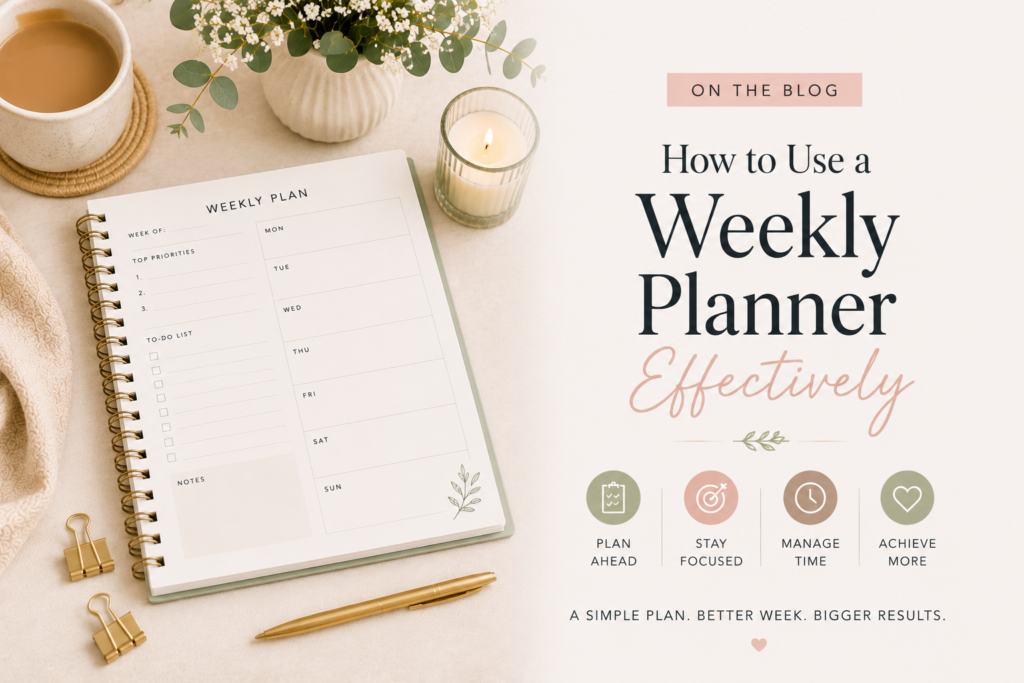
A weekly planner sitting on your desk looks like productivity. Actually using it — consistently, thoughtfully, in a way that moves your life forward — is something else entirely.
Most people start with good intentions. They buy a beautiful planner, fill in the first few days, and then slowly drift back to checking their phone and reacting to whatever arrives in their inbox. The planner gathers dust. The cycle repeats.
The problem is never the planner itself. It is the absence of a system behind it.
When you know how to use a weekly planner, not just that you should, the whole thing clicks into place. Your week stops feeling like a long series of interruptions and starts feeling like something you are genuinely steering. This guide will show you exactly how to get there.
Why Weekly Planning Works Better Than Daily Planning Alone
Daily planning is valuable — but it has a blind spot. When you only look one day ahead, you are constantly reacting. You miss the bigger picture. You say yes to things on Tuesday that quietly destroy your Thursday.
A weekly view gives you perspective. You can see how your commitments actually relate to each other. You can spot conflicts before they happen. You can make deliberate choices about where your time and energy go across the full five or seven days, rather than just the next twenty-four hours.
Think of it this way. Daily planning is like looking at the road directly in front of you. Weekly planning is like checking the map. You need both to reach your destination without running out of fuel halfway there.
Step 1: Choose the Right Planner for How Your Brain Works
Before anything else, your weekly planner needs to match the way you actually think — not the way you think you should think.
Some people love a digital planner. Google Calendar, Notion, or a dedicated app like Sunsama or Reclaim gives them flexibility, syncs across devices, and allows easy rescheduling. If you are managing a lot of moving parts or working across time zones, digital tools have a clear edge.
Other people need paper. There is something about writing by hand that makes commitments feel more real. A physical planner also means no notifications, no open tabs, no distractions. Many people find they think more clearly when they step away from a screen.
Some use both — a paper planner for their priorities and intentions, and a digital calendar for appointments and meetings.
Neither approach is wrong. What matters is picking one and being honest with yourself about which format you will actually use.
Ask yourself: Do I consistently use digital tools or do I avoid them? Do I enjoy writing by hand? Where do I naturally look first when I need to remember something? Let your answers guide your choice.
Step 2: Set Up Your Weekly Planner Template
A good weekly printable planner layout does not need to be complicated. In fact, simpler is almost always better. Here is a structure that works well for most people:
At the top of the week:
- Your three to five key goals or priorities for the week
- Any important deadlines or events that anchor the week
- One personal intention — something beyond work that matters to you this week
For each day:
- Two to three main tasks (not a full list — just the ones that matter most)
- Any fixed appointments or meetings already in your calendar
- A small space for notes or things that come up
At the bottom of the week:
- A brief reflection section: what went well, what to carry forward, what to improve
You do not need to fill every box perfectly. The structure is a guide, not a contract. What it does is give your week a shape before it begins, so you are designing your days rather than just surviving them.
Step 3: Do Your Weekly Planning Session
The most important habit in weekly planning is the planning session itself — a dedicated block of time, once a week, where you sit down and intentionally map out the days ahead.
Most people find that Sunday evening or Friday afternoon works best. Sunday gives you clarity heading into Monday. Friday lets you close the week with intention and walk into the weekend without loose ends hanging over you. Try both and see which feels more natural.
Your planning session does not need to be long. Thirty to forty-five minutes is usually plenty. Here is what to do during that time:
Review the week just finished. Before looking forward, look back briefly. Did you complete what you planned? What got left undone? Were there surprises that threw things off? This is not about judging yourself — it is about gathering useful information.
Check your calendar and commitments. What meetings, appointments, or deadlines are already locked in for the coming week? Write them down or make sure they are visible. These are your fixed points around which everything else gets built.
Identify your top priorities. From your broader goals — work projects, personal commitments, health habits, creative pursuits — what are the most important things to move forward this week? Choose three to five at most.
Assign tasks to days. Look at where your fixed commitments sit and plan your main tasks around them. Heavy meeting days are not the days to schedule deep, focused work. Light days are where you push important projects forward.
Write it down. Seeing your week on paper or on screen, laid out clearly, creates a mental commitment that keeping it in your head simply cannot.
Step 4: Prioritise with Purpose, Not Just Urgency
One of the most common weekly planning mistakes is confusing urgent with important.
Urgent things feel pressing — a message waiting for a reply, a small task someone is chasing you for. Important things are the ones that actually shape where you are headed — the project that will grow your business, the habit that will improve your health, the relationship you want to nurture.
If your week is entirely filled with urgent tasks, you will stay busy but not move forward. If you do not address important priorities until they become urgent, you will always be running behind.
When you are choosing your weekly priorities, ask: what on this list is important but not yet screaming for my attention? Those are often the exact things that deserve the most protected time.
A useful framework here is Stephen Covey’s four-quadrant matrix — sorting tasks by urgency and importance. The quadrant most people neglect is “important but not urgent.” That is where your best long-term work lives.
Step 5: Protect Time for Deep Work
A weekly planner that is only filled with meetings and reactive tasks is not a plan — it is a schedule of interruptions.
Deep work is the focused, uninterrupted effort that produces your best output. Writing, thinking, creating, problem-solving — these all require stretches of time where you can fully concentrate. You cannot do deep work in ten-minute gaps between notifications.
When you plan your week, deliberately block out time for focused work before your calendar fills up with everything else. Treat these blocks like meetings you cannot cancel. Tell colleagues you are unavailable during those windows if you need to.
Even two or three blocks of ninety minutes throughout the week can make a dramatic difference in what you produce.
Step 6: Build in Flexibility
Here is the honest truth about weekly planning: something will not go as planned. A meeting will run long. An urgent issue will appear. A task will take twice as long as you expected. Life is not a spreadsheet.
The solution is not to plan less — it is to plan with flexibility built in.
Leave at least twenty percent of your week unscheduled. This is your buffer for the unexpected, for overflow from tasks that take longer than expected, and for genuine rest. A week that is planned to one hundred percent capacity will break the moment anything changes.
Also, avoid scheduling critical tasks late in the week if you can help it. Earlier in the week gives you recovery room if something slips. Saving important work for Friday is a reliable way to feel permanently behind.
Step 7: Do a Daily Check-In with Your Weekly Plan
Your weekly planner should not only come out once a week. It should be the first thing you glance at each morning.
A two-minute daily check-in looks like this: you open your planner, look at what you planned for today, cross-reference with anything new that has arrived, and decide whether your plan still holds or needs a small adjustment. Then you close the planner and get started.
This habit keeps your day anchored to your weekly intention instead of drifting toward whatever feels easiest or most immediate. It is the difference between running your day and letting your day run you.
Step 8: End the Week with a Proper Review
The weekly review is the habit that turns good planning into great planning.
At the end of each week — during your planning session or as a separate five-minute ritual — ask yourself four simple questions:
What did I accomplish this week? Take a moment to genuinely acknowledge what you got done. Most people skip straight to what they did not finish. That is a mistake. Recognising your wins, even small ones, keeps you motivated and gives you an honest picture of your output.
What did not get done, and why? Be specific. Was it a time issue? A motivation issue? Did the task turn out to be harder than expected? Did something more important take its place? Understanding the why helps you plan more accurately next time.
What surprised me? Unexpected demands on your time reveal patterns. If the same kind of interruption keeps appearing, it deserves a slot in your plan rather than continuing to derail you.
What do I want to focus on next week? Let this week’s experience inform next week’s priorities. Carry forward anything genuinely unfinished. Drop anything that no longer matters. Start fresh with what you now know.
Common Weekly Planning Mistakes to Avoid
Even experienced planners fall into these traps. Watch out for them:
Overpacking the week. If every hour is accounted for, your plan will not survive contact with reality. Plan for sixty to seventy percent of your available time at most.
Copying last week’s unfinished list. Before carrying something forward, ask whether it still deserves your time this week. Incomplete tasks have a way of moving forward indefinitely without ever being questioned.
Ignoring personal priorities. Work tends to expand to fill every available space. Your weekly planner should also include exercise, rest, time with people you care about, and whatever recharges you. These are not luxuries — they are what make sustainable productivity possible.
Planning without reviewing. Planning without reflecting on what happened last week is like sailing without ever checking whether you are on course. The review is what makes the plan smarter over time.
Treating the plan as rigid. A weekly plan is a framework, not a sentence. Adjusting it when circumstances change is not failure. It is intelligent planning.
Making the Habit Stick
The hardest part of using a weekly planner is not the planning itself — it is doing it consistently, week after week, even when life feels too busy to stop and think.
Here are a few things that help:
Anchor your planning session to something you already do. If you always have coffee on Sunday morning, plan then. If you always clear your desk on Friday before leaving, add the review there. Attaching a new habit to an existing one makes it far easier to maintain.
Keep your planner somewhere visible. Out of sight genuinely means out of mind. If your planner is in a drawer, you will not use it. Leave it on your desk, open to the current week.
Start smaller than you think you need to. If committing to a full planning system feels overwhelming, begin with just one habit — the Sunday evening priority list, or the daily morning check-in. Build from there.
Give it four weeks. Most habits need about a month before they start to feel natural. The first week might feel awkward. By the fourth, you will notice something feels off when you skip it.
Pulling It All Together
A weekly planner is not a productivity gadget. It is a tool for living more deliberately — for deciding in advance how you want your time to go rather than looking back at the week wondering where it disappeared to.
The steps are simple: choose the right format, set up a template that works for you, do a consistent planning session each week, protect time for what matters, stay flexible, and review regularly. None of this is complicated. What makes it powerful is doing it consistently.
Your week is going to happen either way. The only question is whether you design it or just endure it.
Start this Sunday. You might be surprised how different Monday morning feels.
Frequently Asked Questions
How long should a weekly planning session take?
For most people, thirty to forty-five minutes is enough. If you find yourself going much longer, you may be over-thinking rather than planning. Keep it focused: review last week, set priorities, assign tasks to days, and close the session.
What is the best day to do weekly planning?
Sunday evening and Friday afternoon are the two most popular options. Sunday gives you a clear head going into Monday. Friday lets you wrap up the week properly and genuinely disconnect over the weekend. Try both for a few weeks and see which one you actually keep doing.
Should I use a paper planner or a digital one?
Whichever one you will consistently open and use. Paper planners encourage more intentional thinking and have zero distractions. Digital planners offer flexibility, syncing, and reminders. Many productive people use a combination of both — paper for priorities, digital for appointments.
How many tasks should I put in my weekly planner per day?
Aim for two to three meaningful tasks per day. This sounds modest, but completing two to three important tasks every day adds up to an incredibly productive week. Resist the urge to list everything — that leads to overwhelm, not output.
What if my week never goes according to plan?
That is normal, and it is not a sign that planning is not working. It means your plans need more buffer time, or your estimates are optimistic, or unexpected demands are worth acknowledging and planning around. The review process at the end of each week helps you learn from this and adjust.