
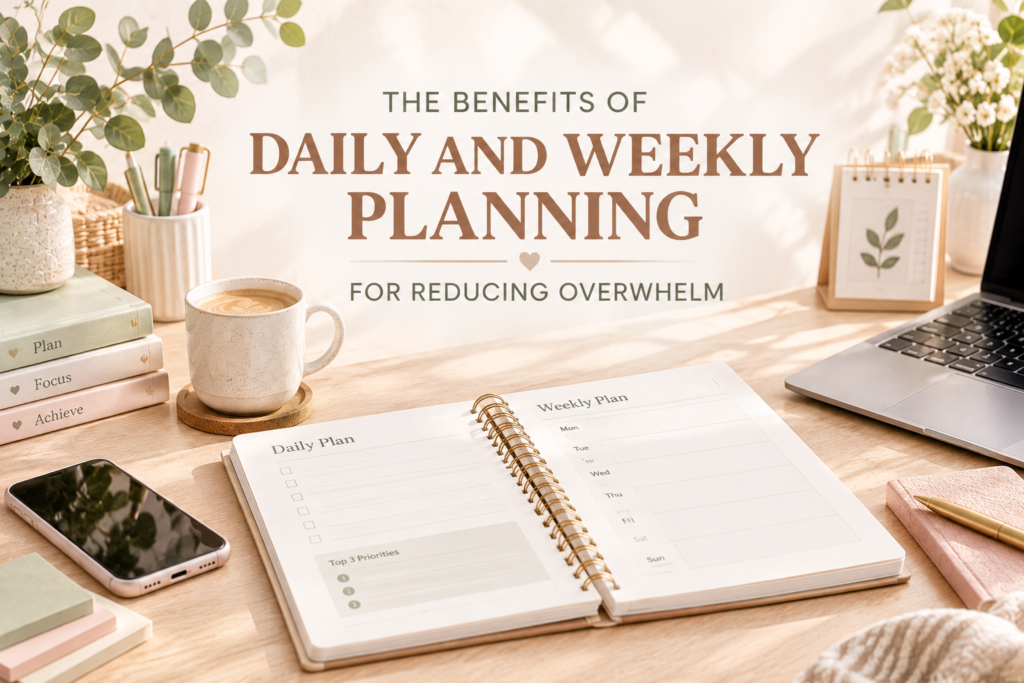
Overwhelm usually gets blamed on having too much to do. That’s rarely the actual cause. Most people who feel overwhelmed could probably finish everything on their plate in a normal week if it were laid out clearly — what makes it feel unmanageable is that it isn’t laid out. It’s floating, undefined, with no visible edge to it. And a task with no visible edge feels infinite, even when it isn’t.
That’s the specific problem daily and weekly planning solves. Not by adding more structure for its own sake, but by giving something shapeless an actual shape.
Overwhelm Is Rarely About Volume — It’s About Not Knowing Where It Ends
Picture two people with the exact same sixteen things to do this week. One of them is carrying it all as a loose mental cloud: work stuff, house stuff, that thing they keep meaning to call about, a vague sense there’s more they’re forgetting. The other has it written across five days, seven items on the busiest day, none on Saturday.
Same sixteen things. Very different experience of carrying them. The first version has no boundary — it could always be worse than you think, because you can’t fully see it. The second version has a floor and a ceiling. You know exactly what “done for today” looks like, which means you can actually reach it.
Writing It Down Gets It Out of Working Memory
Holding a task in your head isn’t free. Part of your attention stays quietly allocated to not forgetting it, even while you’re doing something else entirely — which is why an unrelated task can surface mid-conversation for no obvious reason. It hasn’t gone anywhere; it’s just been sitting in the background, taking up space.
Writing something down is what lets your attention actually let go of it. Not because the task is finished, but because you’ve offloaded the job of remembering it onto the page instead of your own working memory. This is a big part of why planning reduces stress even before a single item gets crossed off — the relief happens at the point of writing, not the point of completing.
A Daily List Turns “Everything” Into a Specific, Finite Number
“Everything I need to do” is not a number. It has no edges, which means it can always feel like more than you can handle, regardless of how much is actually on it. “Seven things, here they are” is a number. Seven is finite. Seven can be looked at, sized up, and finished.
This is the real function of a daily list — not organization for its own sake, but converting an open-ended, anxiety-shaped concept into a bounded, achievable one. The list doesn’t make the work smaller. It makes the shape of the work visible, which is most of what was making it feel unmanageable in the first place.
A Weekly View Keeps the Daily List From Becoming Its Own Problem
Daily lists solve overwhelm, but they can also quietly create a smaller version of it if there’s nothing above them — everything starts feeling urgent because there’s no visible sense of which day something actually belongs to. A weekly view is what prevents that. It lets a task that isn’t due until Thursday stay parked on Thursday, instead of nagging at you from an undated list on Monday.
This is the layer a lot of planning advice skips, and it’s the whole idea behind running a structured weekly routine — the daily list handles today, the weekly view handles where everything else is sitting until it’s actually time for it, which is what keeps the daily list short enough to stay useful.
The Physical Act of Crossing Something Off Does Something an App Checkbox Doesn’t Quite Replicate
There’s a small but real difference between tapping a checkbox and physically crossing a line through something you wrote by hand. The physical version registers more — it’s a small, tangible signal of done, in a way a checkbox that just changes color doesn’t always land the same way. For someone managing overwhelm specifically, that small hit of visible progress matters more than it sounds like it should, because overwhelm often comes with a nagging sense that nothing is actually moving. A crossed-off line is direct evidence against that feeling.
This is part of why the format decision isn’t purely aesthetic — printable versus digital genuinely changes how planning feels day to day, not just how it looks.
It Creates a Legitimate Stopping Point
One of the quieter drivers of overwhelm is not having permission to stop. Without a defined plan, “enough for today” is a judgment call you have to make from scratch every single evening, which is exhausting in its own right and easy to get wrong in the direction of never feeling like you’ve done enough.
A written daily list removes that judgment call. When the list is done, you’re done — not because everything in your life is finished, but because everything you decided belonged to today is. That’s a real, legitimate stopping point, and having one is a bigger relief than it sounds like on paper.
Where Planning Backfires and Adds Overwhelm Instead
Planning isn’t automatically the fix — done wrong, it makes things worse. The usual culprits:
- Scheduling every single minute. A plan with no slack leaves no room for anything running long, and the first delay collapses the whole day, which recreates the exact feeling of being out of control the plan was supposed to prevent.
- Treating the list as sacred rather than a draft. A list that can’t be revised mid-day becomes a source of guilt instead of relief the moment reality doesn’t match it.
- Putting everything on the daily list instead of the weekly one. This is the most common mistake — a fourteen-item daily list is really a weekly list wearing the wrong label, and it will feel exactly as overwhelming as no list at all.
FAQ
Does daily planning actually help if my schedule is unpredictable?
Yes, though the plan needs to flex — a short list of two or three genuinely important items, with everything else parked on the weekly view rather than the day, holds up much better against a schedule that changes often than a tightly scheduled hour-by-hour plan does.
What if the list itself starts to feel overwhelming to look at?
That’s usually a sign too much has been pulled onto the daily page that actually belongs on the weekly one. A daily list longer than five or six real items has generally stopped being a daily list.
How many things should be on a daily list?
Three to six is a reasonable range for most people. Past that, it starts functioning as a weekly list in disguise, and the finite-number effect that makes it feel manageable starts to break down.
Is a weekly or daily plan more important for reducing stress?
They handle different jobs, and the two together are more effective than either alone. The weekly view keeps items in the right time slot instead of all crowding into today; the daily list gives you the short, finite, actually-finishable version of that for the next 24 hours.
If passive visibility and an actual stopping point are the parts that have been missing, that’s the structure behind our daily and weekly planners — and this pairs naturally with the weekly planning routine guide and the budget planner benefits piece already on the site.