
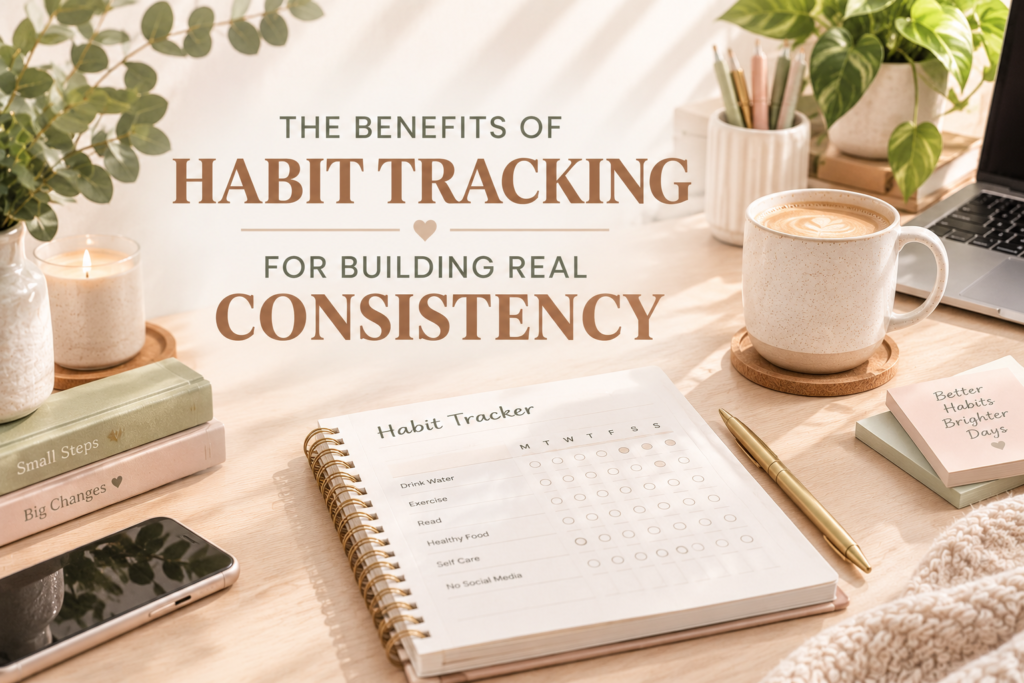
The usual explanation for why habit tracking works is that it “keeps you accountable,” which is true but vague enough to be almost useless. Accountable to what, exactly? There’s no boss checking the page. Nobody’s enforcing anything. The actual mechanism is more specific than that, and understanding it is what makes the difference between a tracker that changes behavior and one that just sits there getting filled in.
It Makes Invisible Progress Visible
Most consistency happens too slowly to notice day to day. You don’t feel meaningfully different after one workout, one budgeted week, or one night of decent sleep — the effect is real but too small to register in the moment. Without a record, that invisibility becomes a problem: if you can’t feel progress happening, it’s easy to conclude nothing’s happening at all, and stop.
A tracker doesn’t make the progress happen faster. It makes it visible at a scale where you can actually see it accumulate — eleven days out of fourteen is a fact you can look at, in a way that “I’ve been decent about this lately” never quite is.
The Streak Effect Isn’t About the Streak — It’s About Seeing the Pattern
There’s a specific reason a filled-in row motivates more than a single good day does, and it isn’t just satisfaction at a visual line. A single day tells you almost nothing about whether the behavior is sticking. Eleven days in a row tells you something real: this is becoming a pattern, not a one-off.
That shift — from “I did this” to “I’m someone who does this” — only happens with enough repetition to see. One checkmark can’t produce it. A row of them can, which is the actual reason streaks feel motivating. It’s not the visual satisfaction. It’s evidence.
It Builds Identity From Evidence, Not Intention
There’s a meaningful difference between deciding you’re the kind of person who exercises and actually having four weeks of marks that prove it. Intention alone is fragile — it can be undone by one bad week, because there was never any real evidence behind it to begin with. A tracked pattern is harder to argue yourself out of, because it’s not a belief you’re holding onto. It’s a fact sitting on the page.
This matters most in the moments when motivation runs out, which happens to everyone eventually. Intention has nothing left to fall back on at that point. A tracker does — the record itself becomes the reason to keep going, independent of how motivated you happen to feel that particular day.
It Catches the Pattern Behind the Slip, Not Just the Slip Itself
A missed day, on its own, says almost nothing. A missed day that’s the fourth Wednesday in a row says something specific and useful. Without a record, that kind of pattern is nearly invisible — you’d need to remember four separate Wednesdays and notice they had something in common, which almost never happens in the moment.
A tracker holds that information for you. Looking back over a few weeks of marks, a repeated gap tends to jump out immediately, and once it’s visible, it’s actually fixable — maybe Wednesdays have a scheduling conflict the habit was never built around. That’s a solvable problem. “I keep failing sometimes” is not.
It Removes a Small but Real Mental Cost
Without a record, “did I already do this today?” is a question you have to answer from memory, which is a small but real drain repeated every single day. A mark on a page answers it instantly, with no recall required. That sounds minor, but it’s one less thing your attention has to hold onto — similar to how writing down a task frees up the working memory that was quietly spent remembering not to forget it.
The Printable Format Has a Specific Advantage Here
This benefit isn’t tied to tracking in general — it’s specific to a version that’s physically visible. An app only gets checked when you open it, which for most habits happens less often than the habit itself needs to be reinforced. A page sitting somewhere you’ll naturally see it — a desk, next to a coffee maker, on a fridge — gets glanced at throughout the day without you deciding to look, which reinforces the habit far more often than a hidden app icon ever will.
That’s the same passive-visibility principle covered in more depth in the printable versus digital planner comparison — for habit-building specifically, it tends to matter more than almost any other use case.
It Protects Against All-or-Nothing Thinking
One missed day can feel like proof the whole effort failed, especially without anything to counter that feeling. A tracker pushes back on it directly — a single blank square next to twenty filled-in ones is visible, undeniable evidence that one miss isn’t the same as starting over. The record itself argues against the all-or-nothing story before it has a chance to take hold.
Without that visual counterweight, one bad day has a way of turning into five, simply because nothing was there to interrupt the narrative that the streak was already ruined.
The Myth Worth Correcting: Tracking Alone Isn’t the Habit
None of this works automatically just because a box gets checked. The behavior change comes from what you notice when you actually look at the pattern — not from the act of marking it. A tracker filled in for a month with no review is really just a decorated record, not much different from not tracking at all.
The setup matters here — specific, honestly-markable habits, a manageable number of them, and an actual review built in. That part is covered in more depth in the habit tracker setup guide — this piece is the why, that one’s the how, and they’re meant to be read together rather than instead of each other.
FAQ
Does habit tracking work better for building new habits or maintaining existing ones?
Both, but for different reasons. For new habits, it provides the early evidence that’s missing before the behavior feels automatic. For existing ones, it catches slow drift — a habit that’s quietly slipping — before it fully disappears.
How long before a tracked habit starts to feel automatic?
This varies a lot by person and habit, generally landing somewhere between three and ten weeks rather than a fixed number. The tracker’s job isn’t to speed that up — it’s to make the in-between period visible enough that you stick with it long enough to get there.
What if tracking itself starts to feel like a chore?
That’s usually a sign there are too many habits on the page, not that tracking doesn’t work. Dropping back to two or three tends to restore it, since a two-second habit to log seldom feels like a burden on its own.
Can habit tracking help with breaking a habit, not just building one?
Yes — tracking the absence of a behavior, or the presence of a replacement one, works on the same mechanism. Seeing three smoke-free days in a row is just as motivating as seeing three workout days in a row, for the same reason: it’s evidence, not just intention.
If visible, physical evidence of progress is the piece that’s been missing, that’s exactly what our habit tracker printables are built for — paired with the setup guide if you’re starting from scratch, or the goal planner guide if the habit is in service of something bigger.