
Most parents have tried a chore chart at some point, often with real initial enthusiasm — a colorful printout, a set of stickers, a genuinely well-intentioned system. And most of these charts share the same eventual fate: enthusiastic use for the first week or two, followed by a gradual, quiet abandonment, until the chart itself becomes just another piece of paper on the fridge that nobody actually references anymore.
This pattern is common enough that it is worth understanding why it happens, rather than simply trying yet another chart design and hoping this time will be different. The reasons chore charts fail are usually specific and addressable — chores that are not genuinely age-appropriate, a system with no real incentive structure, inconsistent parental follow-through, or a chart that requires more maintenance than the actual chores it is meant to track.
This guide covers exactly how to build a chore chart your kids will genuinely follow, including age-appropriate chore ideas, the psychology behind what actually motivates children to participate consistently, and specific chart formats worth trying.
Why Most Chore Charts Fail
The chores listed are not genuinely age-appropriate. A chart with tasks too difficult or too simplistic for a child’s actual developmental stage sets the whole system up for either frustration or boredom, both of which undermine consistent engagement.
There is no genuine, consistent incentive or acknowledgment built into the system. Children, like adults, respond to visible progress and genuine recognition. A chart with no meaningful feedback loop — no reward, no acknowledgment, simply an expectation of compliance — often struggles to sustain engagement beyond initial novelty.
Parents are inconsistent in following up on the chart themselves. If the chart is introduced with enthusiasm but then rarely referenced or reinforced by parents after the first week, children quickly learn that the system does not actually matter, regardless of how well designed it initially appeared.
The chart itself is too complicated to maintain easily. An elaborate system requiring significant ongoing setup or tracking effort from parents becomes its own burden, making it one of the first things to be quietly dropped during a busy week.
Chores are assigned without any child input, reducing genuine buy-in. Children given some degree of choice or input into their responsibilities tend to engage more consistently than those simply assigned a fixed list without any consultation.
Age-Appropriate Chore Ideas
Ages 3–5
Putting toys away in designated bins, helping set the table with non-breakable items, putting dirty clothes in a hamper, wiping up small spills, helping feed a pet with supervision. At this age, chores work best framed as helping alongside a parent rather than fully independent responsibilities.
Ages 6–8
Making their own bed, clearing their own dishes from the table, watering plants, sorting laundry by color, tidying their own room to a basic standard, helping unload simple items from grocery bags. Children at this stage can typically manage short, clearly defined tasks with minimal supervision.
Ages 9–12
Loading and unloading the dishwasher fully, vacuuming a room, taking out the trash and recycling, preparing simple snacks or parts of a meal, folding and putting away their own laundry, walking or caring for a pet more independently. This age group can generally handle multi-step tasks and some degree of genuine independent responsibility.
Ages 13 and Up
Doing their own laundry from start to finish, preparing a full simple meal, mowing the lawn or handling more involved outdoor tasks, deep cleaning a bathroom, managing their own schedule around chore completion with less direct parental reminder. Teenagers can generally take on chores closely resembling genuine household contribution rather than simplified, child-specific tasks.
What Actually Motivates Kids to Follow a Chore Chart
Visible, immediate tracking of completion. Children respond well to seeing their own progress marked visibly — a sticker, a checkmark, a filled-in box — providing the same kind of tangible, satisfying feedback that habit trackers provide for adults.
Some degree of choice within the system. Allowing children to choose between a few age-appropriate chore options, rather than being assigned a completely fixed list, tends to increase genuine engagement and reduce resistance compared to a purely top-down assignment.
Consistent, genuine acknowledgment from parents. A brief, specific comment noting completed chores — rather than only addressing chores when they are not done — reinforces the behavior considerably more effectively than acknowledgment that occurs only around problems or reminders.
A meaningful, appropriately scaled reward system, if used. Whether a small allowance, a specific privilege, or simply a fun family activity tied to consistent chore completion, a genuine incentive — matched appropriately to the child’s age and the family’s values around rewards — provides additional motivation beyond the chart itself.
Clear, specific expectations rather than vague instructions. “Clean your room” is genuinely difficult for a child to interpret consistently. “Put clothes in the hamper, make the bed, and put books back on the shelf” provides a clear, specific, achievable standard.
Chore Chart Formats Worth Trying
The Simple Weekly Grid
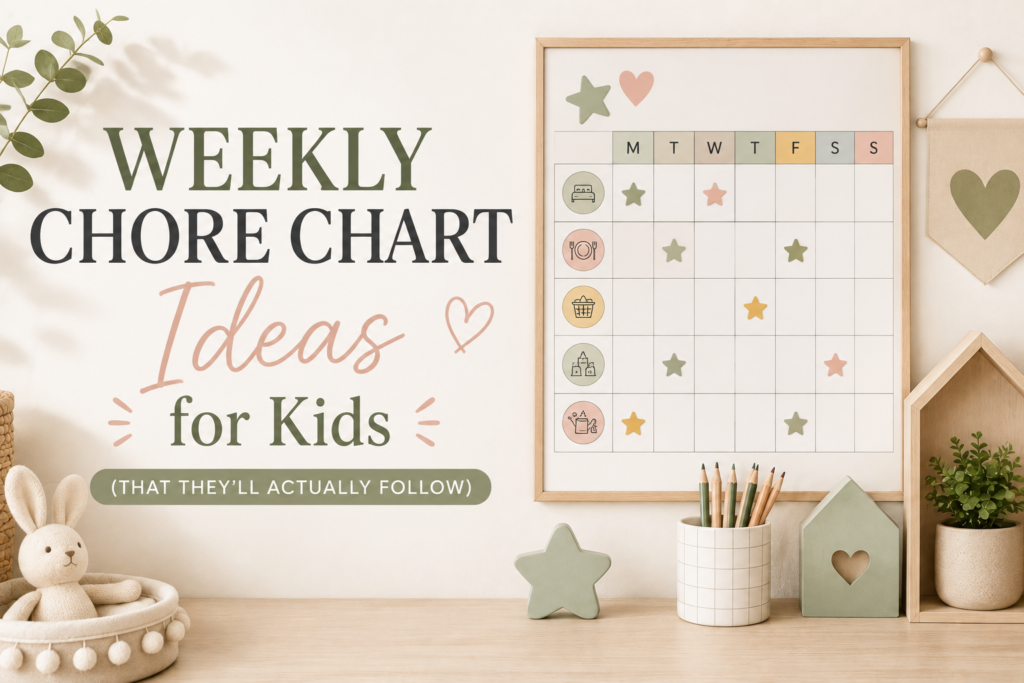
A straightforward grid with days across the top and chores down the side, marked with a sticker or checkmark upon completion. This classic format works well precisely because of its simplicity — easy for children to understand and easy for parents to maintain consistently.
The Rotating Chore Wheel
For households with multiple children, a rotating wheel or chart that shifts specific chore assignments between children on a weekly or monthly basis can reduce the sense of unfairness that can arise when the same child is always assigned the least appealing tasks.
The Choice Board
Rather than fixed daily assignments, a choice board presents several age-appropriate chore options each day, allowing the child to select which ones to complete. This format leverages the genuine motivational benefit of some autonomy within the system.
The Points-Based System
Different chores are assigned different point values based on effort or time required, with children accumulating points toward a specific, meaningful reward. This format works particularly well for older children who can engage with a slightly more complex, strategic system.
The Visual Chart for Younger Children
For children not yet reading fluently, a chart using pictures or simple icons rather than text — a picture of a bed for “make your bed,” a toy bin icon for “put toys away” — makes the system accessible and usable independently, even before strong reading skills have developed.
Building Consistency Around Your Chore Chart
Introduce the chart with a clear, calm explanation, rather than simply posting it and expecting immediate understanding. Walk through the system together, explaining exactly how it works and what is expected, ideally including the child in some of the decision-making about specific chores or rewards.
Check in on the chart at a consistent, predictable time. A brief daily or weekly review — checking off completed tasks together, discussing any that were missed — reinforces the system’s ongoing relevance considerably more than an inconsistent, sporadic check-in pattern.
Follow through consistently on whatever incentive or consequence structure you have established. If rewards or consequences are promised but not consistently delivered, children quickly learn the system does not genuinely matter, undermining engagement considerably faster than almost any other single factor.
Adjust the chart as needed based on what you observe. If certain chores consistently go uncompleted, or if a child has clearly outgrown their current assigned tasks, revise the chart rather than persisting with a system that is not genuinely working as originally designed.
Model consistent household contribution yourself. Children notice and respond to whether household chores appear to be a genuine shared family value or simply something imposed on them specifically. Visible parental participation in household tasks reinforces the chart’s underlying message.
Common Chore Chart Mistakes to Avoid
Assigning too many chores at once, particularly when first introducing the system. Starting with a smaller, genuinely manageable number of chores, then gradually adding more once the initial habit feels established, tends to produce better long-term consistency than an ambitious full list from day one.
Using chores as a form of punishment, which can create negative associations with household contribution generally. Keeping chore expectations separate from disciplinary consequences helps maintain a healthier, more positive framing around the concept of household contribution.
Comparing children’s chore completion to each other in a way that creates resentment. Focus feedback on each child’s own progress and effort, rather than direct comparisons that can create unnecessary sibling tension.
Abandoning the system after a single difficult week without adjustment. Like any new household habit, an initial period of inconsistency while everyone adjusts to the new system is normal. Treat early difficulty as useful information for refinement, rather than evidence the entire approach has failed.
Using a Printed Chore Chart as Part of a Broader Family System
A printed, physical chore chart — kept somewhere visible, ideally as part of a broader family command center — provides the consistent, low-effort visibility that supports genuine ongoing use, without requiring an app or device that adds its own friction to a system meant to be simple and immediately accessible for children. Elabrille‘s family organization pages include chore chart templates designed for different age groups, able to be printed and updated easily as your children grow and their responsibilities naturally evolve.
Pulling It All Together
A chore chart that actually works is not primarily about finding the perfect design — it is about matching genuinely age-appropriate tasks to your child’s developmental stage, building in some degree of choice and meaningful acknowledgment, and maintaining consistent parental follow-through over time. The specific format matters considerably less than these underlying principles.
Start with a smaller, manageable set of age-appropriate chores. Involve your child in some of the decision-making. Check in consistently, and follow through reliably on whatever incentive structure you establish. A simple system, genuinely maintained, will outperform an elaborate one abandoned after a few weeks — every time.
Frequently Asked Questions
What chores are appropriate for a 5-year-old?
Age-appropriate chores for young children typically include putting toys away in designated bins, helping set the table with non-breakable items, putting dirty clothes in a hamper, and wiping up small spills. At this age, chores work best framed as helping alongside a parent rather than fully independent tasks.
Why do chore charts usually stop working after a few weeks?
Common reasons include chores that are not genuinely age-appropriate, a lack of consistent parental follow-through, no meaningful incentive or acknowledgment built into the system, and charts that are too complicated to maintain easily. Addressing these specific issues, rather than simply trying a new chart design, tends to produce better long-term results.
Should I pay my kids for doing chores?
This is a genuinely personal family decision without a universally correct answer. Some families use allowance tied to chores as a motivational tool; others prefer to frame household contribution as a non-monetary family expectation. Whatever approach you choose, consistency in following through matters more than which specific philosophy you adopt.
How many chores should be on a kid’s chart at once?
Start with a smaller, genuinely manageable number, particularly when first introducing a chore chart, and gradually add more once the initial habit feels established. An overly ambitious list from the start tends to overwhelm rather than motivate, particularly for younger children.
What should I do if my child stops following the chore chart?
Review whether the assigned chores remain genuinely age-appropriate, whether you have been consistently following through on acknowledgment or rewards, and whether the system itself has become too complicated to maintain easily. Adjust based on what you observe rather than assuming the child simply lacks motivation — often, the system itself needs refinement.