
Introduction
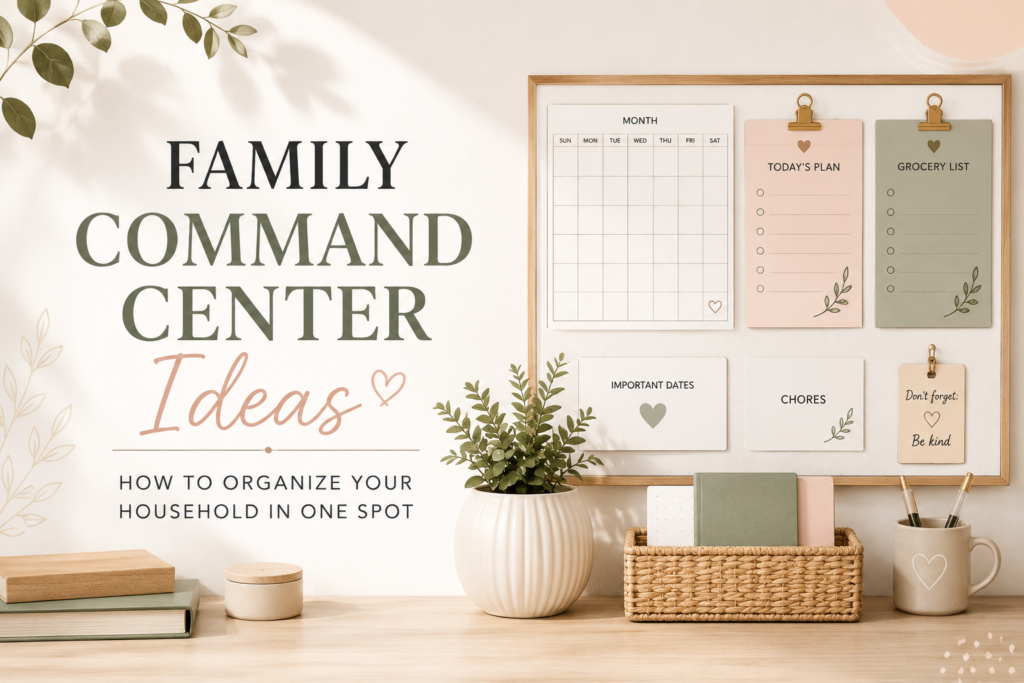
In most busy households, important information lives everywhere and nowhere at once. A permission slip on the kitchen counter, a doctor’s appointment written on a random sticky note, a chore chart abandoned somewhere in a child’s room, a family calendar that only one parent actually checks.
A family command center solves this by creating a single, designated location where the household’s shared, ongoing information genuinely lives — visible, consistent, and accessible to everyone who needs it, rather than scattered across counters, phones, and memory. It does not need to be elaborate or Pinterest-perfect to work.
What a Family Command Center Actually Needs to Do
Before considering specific ideas or layouts, it helps to be clear about the genuine function a command center is meant to serve, since this clarity should drive every decision about what to include.
It needs to hold the household’s shared, ongoing information — not everything, just what genuinely needs to be visible to multiple people. A command center is not a general storage or filing system; it is specifically for the information that needs to be seen and referenced by more than one household member on a regular, ongoing basis.
It needs to be visible and accessible without requiring active searching. Information tucked into a drawer or a closed binder, however well organized, does not provide the passive, glance-and-go visibility that makes a command center genuinely useful compared to a more traditional filing system.
It needs to be located somewhere the household naturally passes through regularly. A command center in a rarely visited room provides little practical benefit, regardless of how well designed it is. Location matters as much as content.
It needs to be simple enough that every relevant household member can actually use and update it, not just the primary organizer. A system requiring specialized knowledge or an unnecessarily complicated process to update tends to fall entirely on one person, defeating much of the shared, household-wide purpose.
Core Elements Worth Including
A Shared Family Calendar
A visible calendar — whether a wall calendar, a whiteboard grid, or a printed weekly or monthly spread — showing the family’s collective schedule at a glance. This is arguably the single most valuable element of any command center, since a shared visual calendar prevents the double-bookings and missed commitments that scattered, individual tracking tends to produce.
A Rotating Weekly or Daily Task Overview
Beyond the broader calendar, a more immediate, near-term view — what is happening today or this week specifically — helps translate the bigger picture into actionable, daily awareness for the whole household.
A Chore or Responsibility Chart
A visible record of who is responsible for what, particularly valuable for households with children old enough to hold some responsibility. Seeing this information consistently, in the same visible location, reduces the need for repeated verbal reminders.
A Mail and Paper Sorting Station
A simple system — even just a few labeled trays or folders — for incoming mail, school papers, and forms requiring action, preventing this genuinely common source of household paper clutter from accumulating on random surfaces throughout the home.
An Emergency and Reference Information Section
Key contact numbers, allergy or medical information, and other important reference details that any household member, including a babysitter or visiting family member, might need quick access to during an unexpected situation.
A Meal Planning Space
A visible weekly meal plan, even a simple one, reduces the daily “what’s for dinner” uncertainty and supports more efficient grocery planning, particularly valuable when visible to the whole household rather than existing only in one person’s head or phone.
A Message or Note Board
A simple space — a whiteboard, a cork board, even a designated notepad — for quick, shared notes between household members that do not require a full conversation: reminders, brief messages, small requests.
Command Center Ideas for Different Amounts of Space
For a Full Wall or Dedicated Area
If you have a genuine, dedicated wall space — a mudroom, a section of the kitchen — you can build a comprehensive command center including all the core elements above, organized into clearly defined sections: a large calendar, a chore chart, a mail sorting station, and a message board, all visible simultaneously.
For a Smaller Kitchen Wall Section
With more limited space, prioritize the elements that provide the most genuine daily value — typically the shared calendar and a simple mail sorting system — and consider a compact, multi-purpose printed page combining a weekly overview, meal plan, and key reminders into a single, regularly updated sheet rather than several separate elements.
For a Cabinet Door or Pantry Door
A command center does not require open wall space.
For a Binder-Based Approach
If wall space is genuinely limited or you prefer a more contained system, a dedicated household binder, kept in a consistent, easily accessible location, can serve much of the same function as a wall-based command center — provided it remains genuinely easy to access and update rather than being stored somewhere inconvenient.
For a Portable, Tabletop Version
A small caddy or organizer kept on a counter or table, containing key papers, a compact calendar, and essential reference information, works well for households wanting the core function without any permanent wall installation.
Building Household Habits Around Your Command Center
Establish a specific, regular time for updating the calendar and key information. A brief weekly family check-in — even five minutes on a Sunday evening — reviewing the coming week’s schedule together at the command center reinforces both its function and everyone’s familiarity with checking it.
Place the command center directly in a location people already pass through regularly, rather than requiring a special trip to check it. Proximity to a naturally occurring daily routine — near the exit door, in the kitchen — significantly increases genuine, consistent engagement.
Involve children in age-appropriate ways from the start. Even young children can learn to check a visual chore chart or a simple calendar; involving them early builds the household habit of using the command center as a genuinely shared family resource, not just a parent’s organizational tool.
Keep the system simple enough to maintain consistently, resisting the urge toward elaborate, high-maintenance design. A command center requiring significant ongoing effort to keep updated and organized is considerably more likely to be abandoned than a simpler system that is genuinely sustainable for your household’s actual capacity.
Common Family Command Center Mistakes
Making it too elaborate to maintain consistently. An impressively designed, highly detailed system can become its own burden if keeping it updated requires more time and effort than the household can genuinely sustain. Start simpler, and add complexity only if the basic version proves genuinely insufficient.
Placing it somewhere inconvenient or rarely encountered. A beautifully organized command center in a room the family rarely enters provides minimal practical benefit compared to a simpler system placed directly in a high-traffic area.
Building it around only one household member’s needs, rather than the whole family’s. A command center that only reflects one parent’s schedule and priorities, without genuinely serving other household members’ needs, tends to be used and maintained by that single person alone, missing much of the shared, collaborative purpose.
Not establishing a consistent update routine. A command center that is set up once with great care but never regularly revisited and updated quickly becomes outdated, undermining its usefulness as a reliable, current source of household information.
Using a Printed System as the Foundation
Whether wall-mounted or contained in a binder, printed pages — a weekly calendar spread, a chore chart, a meal planning page — provide a consistent, easily updatable foundation for a command center, without requiring specialized equipment like a whiteboard or elaborate wall-mounted system. Printable pages can also be easily replaced or updated as your family’s needs change, without needing to redesign an entire physical installation. Elabrille‘s family and household planning bundle includes printable pages specifically designed for a command center approach — weekly calendars, chore charts, and meal planning pages that work together as one cohesive system rather than separately designed pieces.
Pulling It All Together
A family command center does not need to be elaborate or picture-perfect to genuinely work. It needs to hold the household’s shared, ongoing information in one consistent, visible location, and it needs the whole family to actually use and maintain it as a regular habit, not just a one-time organizational project.
Start with the elements that address your household’s most pressing current challenges — likely a shared calendar and a chore or responsibility chart for most families — and expand gradually as needed. Place it somewhere genuinely convenient, involve every household member appropriately, and build a simple, consistent routine around keeping it updated.
Frequently Asked Questions
What should be included in a family command center?
Core elements typically include a shared family calendar, a chore or responsibility chart, a mail and paper sorting station, emergency and reference information, and a meal planning space. The specific combination should reflect your household’s actual, current needs rather than including every possible element by default.
Where is the best location for a family command center?
A location the household naturally passes through regularly — a kitchen wall, near a main exit door, inside a frequently used cabinet door — works considerably better than a dedicated but rarely visited space. Convenience and natural visibility matter more than an ideal, spacious location that the family does not actually pass by often.
How do I get my family to actually use the command center consistently?
Establish a specific, regular time — even a brief weekly check-in — for reviewing and updating it together, place it somewhere genuinely convenient within existing daily routines, and involve children in age-appropriate ways from the start. Consistent use depends more on habit-building than on the specific design of the system itself.
Do I need a lot of space for a family command center?
The key is genuine consistency of use, not the physical size or elaborateness of the setup.
How often should I update our family command center?
A weekly update, reviewing and refreshing the coming week’s calendar and key information, works well for most households. Some elements, like emergency reference information, only need occasional review, while the calendar and near-term task overview benefit from more frequent, regular updating.