
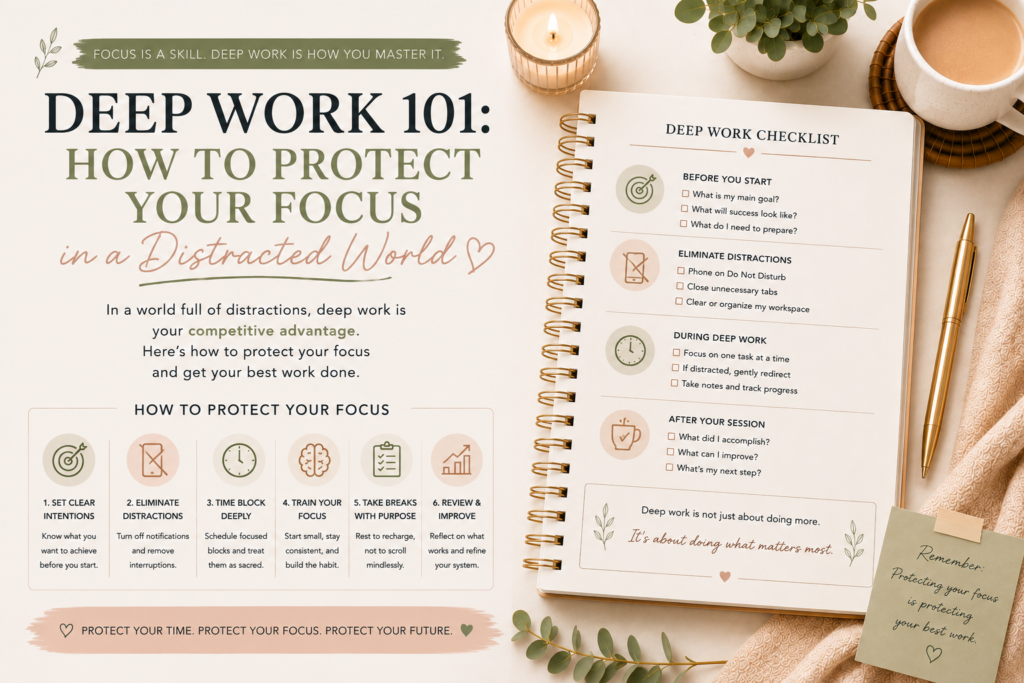
There is a particular kind of work that produces disproportionate results relative to the time invested — sustained, undistracted focus on a single, cognitively demanding task, held for an extended, uninterrupted period. This is what the concept of deep work, popularised by computer scientist and author Cal Newport, refers to. And for most people in most modern working environments, it has become genuinely rare, not because it stopped being valuable, but because the conditions required to sustain it have become increasingly difficult to protect.
Notifications, open-plan offices, chat applications expecting near-immediate responses, and a general cultural expectation of constant availability have created an environment almost perfectly designed to prevent the kind of sustained, uninterrupted attention that produces genuinely excellent work. The irony is that as this kind of focus has become rarer, it has also become more valuable — precisely because fewer people are able to consistently produce it.
This guide covers what deep work actually means, why it matters considerably more than most daily schedules currently reflect, and a practical framework for protecting it within a working life that was not designed to accommodate it.
What Deep Work Actually Means
Deep work refers to professional activities performed in a state of distraction-free concentration that push your cognitive capabilities to their genuine limit. This is distinguished from what Newport terms shallow work — logistical, often low-value tasks performed while distracted, that do not meaningfully develop new value or require significant cognitive effort: routine email, administrative tasks, most meetings.
The defining features of genuine deep work are sustained, uninterrupted attention and a genuinely demanding cognitive task. Both elements matter. Sustained attention on a genuinely trivial task does not produce deep work’s benefits. Similarly, a demanding task attempted amid constant interruption never actually reaches the state of deep focus required to fully engage with it.
Why Deep Work Has Become Genuinely Scarce
Digital communication tools have created an expectation of near-constant availability. Instant messaging, in particular, has normalised an expectation of rapid response that makes extended periods of unavailability feel, to many people, like a violation of professional norms rather than a reasonable and valuable boundary.
Open, collaborative work environments, whether physical or virtual, are structurally opposed to sustained focus. Open-plan offices and constantly active team communication channels are designed to facilitate quick collaboration, but this same design actively works against the sustained, uninterrupted conditions that deep work requires.
Shallow work often feels more immediately productive, even when it is not. Clearing an inbox, attending meetings, and responding to messages all produce a visible sense of activity and completion. Deep work, by contrast, can feel slow and its progress less immediately visible, even when it is producing considerably more genuine value over time.
Attention itself has been degraded by habitual fragmentation. Regular engagement with rapidly switching, high-stimulation digital content — social media, constant notifications — appears to reduce the general capacity for sustained attention over time, making genuinely deep focus progressively harder to access even when circumstances would otherwise allow for it.
Why Deep Work Matters More as It Becomes Rarer
Genuinely valuable, differentiated work increasingly requires it. As routine, easily replicated tasks become increasingly automated or commoditised, the kind of work that remains distinctly valuable — complex problem-solving, genuine creative work, deep expertise — increasingly requires exactly the sustained, focused attention that deep work describes.
The scarcity itself creates a competitive advantage. Precisely because sustained, distraction-free focus has become rare, the ability to consistently produce it represents a genuine differentiator. Those who can reliably access deep work are able to produce results that those operating primarily in a fragmented, shallow mode simply cannot match, regardless of total hours worked.
Deep work produces disproportionate results relative to time invested. A relatively short period of genuine, undistracted focus on a demanding task frequently produces more meaningful progress than a considerably longer period of fragmented, interrupted effort on the same task.
How to Build Deep Work Into a Genuinely Distracted Schedule
Step 1: Identify Which of Your Tasks Genuinely Require Deep Work
Not everything on your plate demands this level of focus. Distinguish clearly between tasks that genuinely benefit from sustained, distraction-free concentration — complex analysis, significant creative work, difficult problem-solving — and tasks that are better classified as shallow work, which do not require the same protected conditions.
Step 2: Schedule Specific, Protected Blocks for Deep Work
Rather than hoping deep work will happen whenever a gap in your schedule allows, deliberately schedule specific blocks — ideally during your genuine peak energy period — and protect them with the same seriousness as an external meeting.
Step 3: Eliminate Every Accessible Source of Interruption During These Blocks
Close email and messaging applications entirely, rather than simply minimising them. Put your phone in a different room or on a setting that fully blocks notifications. Communicate your unavailability clearly to colleagues or family members, if relevant, for the duration of the block.
Step 4: Start With Shorter Blocks and Build Sustained Focus Gradually
If deep, uninterrupted focus has become genuinely unfamiliar, attempting a three-hour block immediately is likely to prove difficult and discouraging. Start with something more modest — perhaps forty-five minutes to an hour — and gradually extend the duration as your capacity for sustained attention rebuilds.
Step 5: Create a Consistent Ritual Around Entering Deep Work
A consistent starting ritual — a specific location, a particular cue, even something as simple as making a cup of tea before beginning — helps signal to your mind that a shift into focused work is beginning, making the transition into deep concentration somewhat faster and more reliable over time.
Step 6: Protect a Consistent Time, Not Just an Occasional One
Deep work becomes considerably easier to sustain when it happens at a consistent time, ideally daily or close to it, rather than sporadically whenever a gap happens to appear. Consistency allows both your own habits and other people’s expectations to adjust around this protected time.
Handling the Inevitable Pressure to Break Deep Work Blocks
Protecting deep work in a genuinely collaborative environment requires actively managing the pressure — both external and internal — to interrupt it.
Communicate your deep work schedule clearly and in advance. Colleagues are generally far more understanding of a clearly communicated period of unavailability than an unexplained one. A simple, direct statement of your protected hours, shared proactively, tends to significantly reduce the friction of maintaining the boundary.
Distinguish genuine urgency from habitual urgency. Very few requests that arrive during a deep work block are genuinely time-critical enough to require an immediate interruption. Most can wait until the block concludes without meaningful consequence, even though they may feel urgent in the moment they arrive.
Address the internal pull to check messages, not just the external pressure. Beyond managing other people’s expectations, many people experience a genuine internal urge to check notifications during a deep work block, driven by habit rather than any actual need. Recognising this pull as habitual, rather than a genuine signal that something requires attention, makes it considerably easier to resist.
Build organisational or team-level norms around protected focus time, if you have any influence over this. Where possible, advocating for broader recognition of protected focus time — even something as simple as an agreed “no meetings” block across a team — makes individual deep work considerably easier to sustain than fighting for it alone against an unsupportive default culture.
What Deep Work Is Not
It is worth being clear about a few common misunderstandings.
Deep work is not simply working longer hours. The value comes from the quality and depth of focus during the time spent, not from extending the total duration of work. A shorter period of genuine deep focus frequently outproduces a much longer period of fragmented, interrupted effort.
Deep work is not appropriate for every type of task. Routine, low-complexity tasks do not require or particularly benefit from the same protected, distraction-free conditions. Applying deep work principles indiscriminately to every task wastes the practice’s genuine value on work that does not need it.
Deep work is not a claim that collaboration and communication have no value. The goal is not to eliminate collaborative or responsive work entirely, but to ensure that genuinely demanding, high-value work receives dedicated, protected conditions rather than being permanently squeezed into the margins of a constantly interrupted day.
Tracking and Sustaining a Deep Work Practice
Building a consistent deep work habit benefits from the same tracking principles that support any other significant habit. Marking each day you successfully protected and used a deep work block, using a simple visible tracker, reinforces the consistency of the practice and provides honest, ongoing feedback about how well the habit is genuinely being maintained over time, not just in an idealised plan. A weekly planner with a dedicated space to note your planned deep work blocks, alongside a simple tracking element for whether each one was actually protected as intended, helps keep this genuinely valuable but easily displaced practice visible and accountable within your broader weekly structure. Elabrille’s productivity planner range includes exactly this kind of protected time-blocking and consistency tracking.
Pulling It All Together
Building a sustainable deep work practice requires more than good intentions. It requires specifically scheduled, genuinely protected blocks of time, deliberate elimination of accessible interruptions during those blocks, clear communication with the people around you, and a willingness to start smaller than your eventual goal while your capacity for sustained focus gradually rebuilds.
In a working world increasingly defined by fragmentation, the deliberate, protected practice of deep work is not a luxury. It is one of the most genuinely high-leverage habits available to anyone whose work benefits from real, sustained thinking.
Frequently Asked Questions
What is deep work?
Deep work refers to professional activities performed in a state of distraction-free concentration that push your cognitive capabilities to their genuine limit, producing new value and being difficult to replicate.
How long should a deep work session last?
This varies by individual and task, but many people start with sessions of forty-five minutes to an hour, particularly if sustained focus has become unfamiliar, and gradually extend the duration over time as their capacity rebuilds. Experienced practitioners often work in blocks of two to three hours for their most demanding tasks.
How do I protect deep work time when my job requires constant availability?
Communicate your specific deep work schedule clearly and in advance to colleagues, distinguish between genuinely urgent requests and those that merely feel urgent, and consider advocating for broader team-level norms around protected focus time if you have any influence over this. Even partial protection — a single daily block — provides meaningful benefit over no protected time at all.
What is the difference between deep work and simply working hard?
Deep work specifically refers to sustained, distraction-free concentration on cognitively demanding tasks. Working hard can occur in a fragmented, frequently interrupted state that, despite significant effort and time invested, does not produce the same depth of focus or quality of output that genuine deep work achieves.