
Most grocery lists serve exactly one purpose: preventing you from forgetting an item once you are actually in the store. This is genuinely useful, but it represents only a fraction of what a well-designed grocery list system can actually accomplish. Built with a bit more intention, the same list becomes a genuine budgeting tool — reducing impulse purchases, minimizing food waste, and giving you a considerably clearer sense of your actual grocery spending before you ever reach the checkout.
The difference between a basic list and a genuinely money-saving system comes down to a handful of specific design choices: how the list is organized, what information it includes beyond just item names, and how it connects to your broader meal planning and budgeting habits. This guide covers exactly how to build that more effective system.
Why a Basic Grocery List Does Not Save You Money on Its Own
A list with no connection to an actual meal plan still allows for considerable impulse buying and mismatched ingredients. Without a specific plan behind each listed item, it becomes easy to purchase ingredients that do not actually combine into complete, usable meals, resulting in partial ingredients going unused.
A list with no budget awareness provides no real spending guardrail. Simply listing needed items, without any accompanying sense of estimated cost, offers little protection against a shopping trip that significantly exceeds your intended grocery budget.
A disorganized list encourages more time spent browsing the store, which increases exposure to impulse purchases. A list that requires backtracking through the store, rather than following a logical path through sections, extends your time in the store and correspondingly increases opportunities for unplanned additions to your cart.
A list with no reference to current pantry inventory can lead to unnecessary duplicate purchases. Without checking what you already have, it is easy to buy items you do not actually need, simply because they appeared on a general list without verification against your actual current supply.
Building a Grocery List System That Genuinely Saves Money
Connect Every Item to Your Actual Meal Plan
Before adding anything to your list, ensure it corresponds to a specific planned meal, rather than a general sense that the item might be useful at some point. This single practice dramatically reduces the kind of speculative purchasing that often results in unused, wasted ingredients.
Organize Your List by Store Section, Not Random Order
A list organized to match your store’s actual layout — produce, dairy, pantry, proteins, in the order you typically encounter them — reduces both your time in the store and your exposure to sections you did not originally intend to browse, where impulse purchases are considerably more likely to occur.
Check Your Pantry and Fridge Before Finalizing Your List
A brief inventory check before shopping prevents purchasing items you already have on hand, directly reducing unnecessary spending on genuine duplicates.
Include a Rough Price Estimate Next to Higher-Cost Items
For items with meaningful cost variation or higher individual price points, noting a rough expected price helps you stay aware of your running total as you shop, rather than discovering the full cost only at checkout.
Set a Specific Budget Figure at the Top of Your List
Writing your intended total grocery budget directly on your list, before you begin shopping, provides a genuine, visible reference point to check against as you add items to your cart, rather than an abstract intention held only in your head.
Leave a Small, Deliberate Buffer for Genuinely Unplanned Needs
Rather than a completely rigid list with zero flexibility, build in a small amount of deliberate buffer — both in your budget and your list itself — for the occasional genuine need that arises unexpectedly, preventing the frustration and potential list-abandonment that a completely inflexible system can produce.
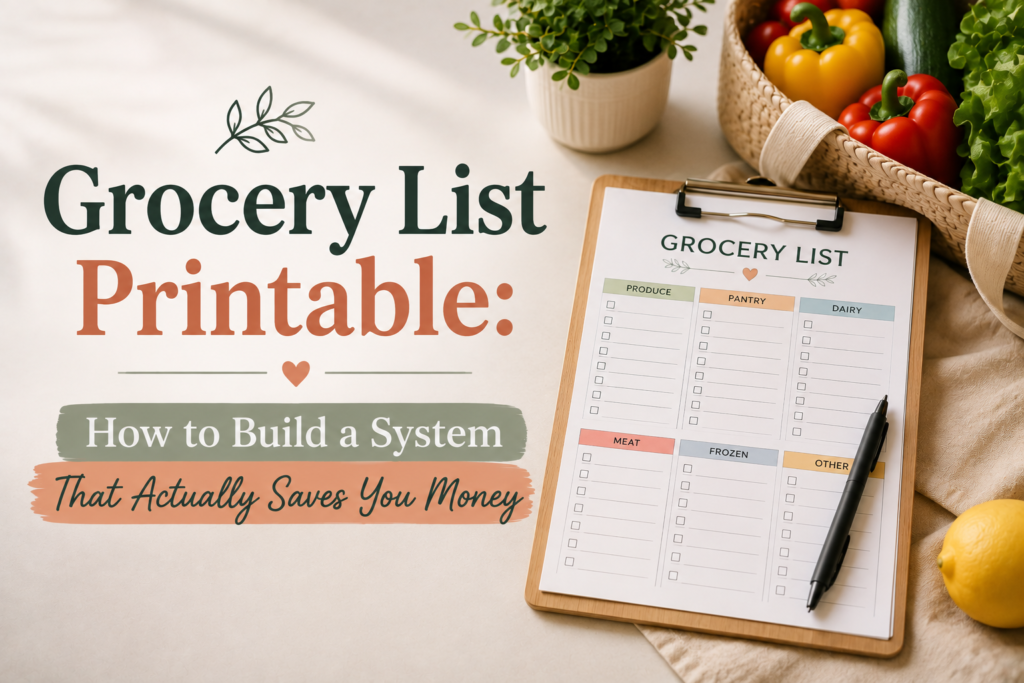
A Grocery List Template Structure Worth Using
Header section: Date, total budget for this trip, and a note of any specific sales or promotions you want to check for.
Produce section: Items organized together, matching your store’s typical produce section layout.
Dairy and refrigerated section: Grouped separately from pantry items, matching typical store organization.
Pantry and dry goods section: Grouped together, again reflecting how most grocery stores organize this category.
Protein and meat section: A distinct section, given both its typical store placement and its often higher per-item cost, worth tracking with particular attention.
Household and non-food items: Kept separate from food items, since these often come from a different part of the store and can otherwise disrupt an efficient shopping route.
A running total or checkbox column: Space to note actual prices as you shop, allowing you to track your running total against your stated budget in real time, rather than only discovering the full cost at checkout.
Additional Strategies to Reduce Grocery Spending Using Your List
Shop with your list after eating, not while hungry. This well-documented effect on impulse food purchasing is easy to address simply by timing your shopping trip deliberately around a meal, rather than shopping on an empty stomach.
Stick closely to your list, treating unplanned additions as a deliberate exception rather than a default. A list provides genuine budget protection only if it is actually followed closely, rather than treated as a loose suggestion easily overridden by in-store impulses.
Check unit prices, not just total package prices, when comparing similar products. Larger packages are not always genuinely cheaper per unit; a quick unit price comparison, easily available on most store shelf labels, ensures you are making an accurate cost comparison rather than assuming based on total price alone.
Plan around sales and seasonal pricing when building your meal plan, not after your list is already finalized. Checking current promotions before finalizing your meal plan, rather than after, allows genuine cost savings to actually influence your meal choices rather than being noticed too late to act on.
Review your actual spending against your planned budget after each trip, not just occasionally. A brief comparison between your list’s intended budget and your actual receipt total, done consistently after each shopping trip, builds an increasingly accurate sense of your genuine grocery costs over time, improving the accuracy of future budget estimates.
Reducing Food Waste Through Better List Planning
Grocery spending and food waste are closely connected — money spent on ingredients that are ultimately thrown away represents a direct, avoidable loss regardless of how reasonably priced the original purchase was.
Buy perishable items in quantities that genuinely match your planned meals, rather than defaulting to standard package sizes regardless of actual need. If a recipe calls for a partial quantity of a perishable item, consider whether you have another planned use for the remainder, or whether a smaller purchase, even at a slightly higher per-unit cost, ultimately produces less waste and genuine cost overall.
Prioritize using ingredients approaching their expiry in your meal planning, checked during your pre-shopping pantry scan. Building this into your regular process, rather than only addressing near-expired items when they are noticed by chance, considerably reduces the frequency of genuinely wasted food.
Track patterns in what you consistently end up throwing away, and adjust your future list-building accordingly. If a specific item is regularly purchased but frequently wasted, this is useful, specific information for adjusting either the quantity purchased or whether to continue including it in your regular rotation at all.
Using a Printed Grocery List Template Consistently
A consistent, pre-formatted grocery list template — organized by store section, with space for your budget and a running total — removes the setup effort from each individual shopping trip, since you are filling in an established, efficient structure rather than creating a new list format each time. This consistency also makes the budget-tracking and comparison process considerably easier over time, since each week’s list follows the same reliable format. Elabrille’s grocery list and meal planning pages are designed to work together directly, connecting your weekly meal plan to a pre-organized, budget-aware shopping list template.
Pulling It All Together
A grocery list can be considerably more than a simple memory aid. Built with genuine intention — connected directly to your meal plan, organized by store section, including a visible budget figure, and checked against your actual pantry inventory beforehand — the same list becomes a genuine tool for reducing both impulse spending and food waste.
Connect every listed item to an actual planned meal. Organize by store section to reduce time and impulse exposure. Set and track a specific budget figure. And review your actual spending against your plan after each trip, building an increasingly accurate picture of your genuine grocery costs over time.
Frequently Asked Questions
How can a grocery list actually help me save money, not just remember items?
A grocery list saves money when it is connected directly to an actual meal plan, includes a visible budget figure to track against as you shop, and is organized by store section to reduce impulse-purchase exposure. Simply listing items without these additional elements provides considerably less genuine budget protection.
What is the best way to organize a grocery list?
Organize items by store section — produce, dairy, pantry, proteins — matching the layout you typically encounter while shopping. This reduces both your total time in the store and your exposure to sections you had not originally planned to browse, where impulse purchases are more likely.
Should I check my pantry before making a grocery list?
Yes, a brief inventory check before finalizing your list prevents purchasing items you already have on hand, directly reducing unnecessary duplicate spending. This step also helps you prioritize using ingredients approaching their expiry in your upcoming meal plan.
How do I stick to a grocery budget while shopping?
Write your intended budget directly at the top of your list before shopping, and track a running total as you add items to your cart, either by noting rough price estimates in advance or checking prices as you shop. This transforms your budget from an abstract intention into a visible, trackable reference point.
Does meal planning really reduce grocery costs?
Yes, significantly. Meal planning connects every grocery purchase to a specific intended use, considerably reducing the speculative purchasing that often results in unused, wasted ingredients. It also allows you to plan around current sales and seasonal pricing in advance, rather than discovering savings opportunities only after your list and budget are already finalized.